



7.4.5 Assistance to Low-Carbon Innovation
Enabling Innovation for a Resource-Efficient and Low-Carbon Future
Institutional Approach
At TMU, the transition towards affordable, reliable and sustainable energy requires an enabling environment in which low-carbon ideas can progress from academic exploration to practical application. In alignment with Sustainable Affordable and Clean Energy, we support low-carbon innovation through research and development, technology-oriented education, intellectual property generation, sustainability-focused entrepreneurship, interdisciplinary collaboration and institutional sustainability initiatives.
Our approach connects academic knowledge with emerging solutions in renewable energy, energy efficiency, smart energy systems, sustainable materials, electric mobility and circular resource utilisation. By bringing together faculty expertise, student learning, research activities and innovation-oriented engagement, the University contributes to developing the knowledge and technical capabilities needed to address energy-related challenges and reduce dependence on resource-intensive practices.
Clean Energy Research, Innovation and Sustainability Pathway
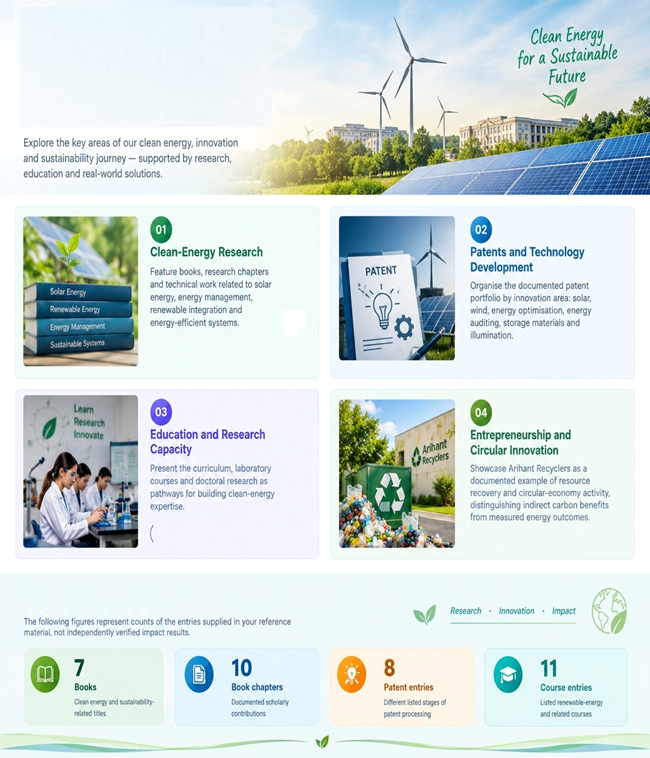
Overview of TMU's 4 core pillars: Clean-Energy Research, Patents & Technology Development, Education & Research Capacity, and Entrepreneurship & Circular Innovation.
1. Research and Knowledge Creation for Clean Energy
TMU promotes sustainability-oriented knowledge creation through faculty publications, scholarly books and research chapters addressing renewable energy, bioenergy, energy management, efficient computing systems and sustainable technologies.
Scholarly Books
| S. No. | Name of Faculty | Title | ISBN | Publisher |
|---|---|---|---|---|
| 1 | Dr. Diptonil Banerjee | Advances in Clean Energy and Sustainability | 978-981-97-5418-2 | Springer Nature Link |
| 2 | Dr. Harsh Vardhan | Advancing Sustainability: Innovations in Renewable Energy, Waste | 978-81-985786-5-5 | Cosmic Books |
| 3 | Nitin Kumar Saxena, David Wenzhong Gao, Ashwani Kumar | Energy Management in Renewable Sources Integrated System | 978-981-96-1012-9 | Springer Nature |
| 4 | Arpita Tripathi | Energy, Ecology, and Environment: Fundamentals and Applications | 978-93-9112-086-3 | Akshita Publishers And Distributors |
| 5 | Souvik Sur | Wind and Solar Energy | 978-81-69011-77-8 | BR Publications |
| 6 | Nikita Jain | Convergent Science and Technology for Sustainable Human Development: Integrated Innovations in Health, Energy, Environment, Agriculture, and Education | 978-8-168-53867-2 | Vaagai International Publishing House |
| 7 | Rupal Gupta | Energy Efficient Internet of Things-Based Wireless Sensor Network | 978-1-394-31472-0 | Wiley |
Book Chapters
| Sr. No | Name of Faculty | Title of the Book | Title of the Chapter | Year | ISBN/ISSN Number |
|---|---|---|---|---|---|
| 1 | Shakuli Saxena | Management of Water and Fertilizer for Agriculture | Harvesting crop residues for bioenergy: Effects on soil health and plant development | 2023 | 978-81-19199-69-3 |
| 2 | Dr. Harsh Vardhan | Advancing Sustainability: Innovations in Renewable Energy, Waste | Advancing sustainability: innovations in renewable energy, waste management, and agriculture for a resilient future | 2025 | 978-81-985786-5-5 |
| 3 | Umesh Kumar Singh, Vinayak Mishra, Akshit Jain, Doshi Saumya Rakesh Kumar | 13th International Conference on System Modeling & Advancement in Research Trends (SMART) | Neural Network Controlled Grid Synchronization of Single-Phase Inverter Using SOGI-PLL for Efficient Solar Power Integration | 2025 | 979-8-3503-8058-3 |
| 4 | K. Madhura, Shalini Ninoria, Arvind Tripathy, Tanushree Sharma, Vivek Deshpande, Ankur Gupta, Sabyasachi Pramanik | Innovation and Sustainability Through Circular Economy in Businesses | The Fifth Industrial Revolution: Blue Wind Energy for Environmentally Responsible Urbanization and Intelligent Energy Management | 2025 | 979-8-36934-124-7 |
| 5 | Preeti Rani | Lecture Notes in Electrical Engineering / Springer | EECP2-IOT: Energy-Efficient Clustering Protocols for Performance Optimization of Internet of Things-Based Heterogeneous and Homogeneous Wireless Sensor Networks | 2025 | 978-981-96-2771-4 |
| 6 | Shivanki Rani | Akshita Publisher and Distributer | Urban Ecology and Energy Consumption | 2025 | 978-93-91120-86-3 |
| 7 | Maneesh Yadav | Countries Studies | Book Review: The Role of Green and Transition Finance in Achieving Carbon Neutrality and Sustainable Energy | 2025 | 2980-9193 (ISSN) |
| 8 | Arpita Tripathi | ABS Books | Sustainability at Stake: Ecological Perspectives on Bioenergy Production | 2025 | 978-9-349-07821-5 |
| 9 | Rupal Gupta | Energy Efficient Internet of Things-Based Wireless Sensor Network | Edge Computing for Energy Efficient IoT | 2026 | 978-1-394-31472-0 |
| 10 | Rohit Kumar Singh Gautam | Renewable Power for Sustainable Growth (Hardcover) | A Comprehensive Review of Machine Learning Paradigms to Forecast Energy in Thermoelectric Powered IoT Devices | 2026 | 978-9-819-52148-7 |
2. Patent-Based Innovation and Technology Development
TMU's documented patent portfolio includes innovations relating to solar-energy harvesting, wind-energy harvesting, energy regeneration, energy distribution optimisation, solar-assisted indoor illumination, drone-based energy auditing and solar-energy integration in unmanned aerial vehicles.
| S. No. | Patent Application No. | Title of the Patent / Copyright | Patentor / Awardee | Year | Applicant (College) | Status |
|---|---|---|---|---|---|---|
| 1 | 202211001092 | Method and formula (Osama formula) development for drone based energy auditing for a sustainable building envelope | Dr. Pankaj Goswami | 2022 | FoE | Published |
| 2 | 202311009876 | Energy Regeneration Device | Mayur Agarwal | 2023 | TMU (Engineering) | Published |
| 3 | 202611055124 | Solar energy integration in UAV | 1. Prince Bhupender 2. Pratap Singh 3. Rajat Jain 4. Paras Jain 5. Dr. Raghvendra Tiwari |
2026 | Engineering | Filed |
| 4 | 202611055127 | Citrus-waste-derived pectin solid biopolymer electrolyte film for green energy storage (Solid Electrolyte Films from Citrus-Derived Pectin for Li Ion Conduction) | 1. Dr. Diptonil Banerjee 2. Prabhakar Sharma |
2026 | Engineering | Published |
| 5 | 202211017050 | A bio-solar cell-based system for efficient harvesting of solar energy | 1. Dr. Surendra Kumar Yadav 2. Dr. Vinoth Kumar 3. Dr. Deivasigamani 4. Dr. P. Pramila 5. Rashmi Suresh Bakhtiani 6. Dr. N. Murugalatha 7. D. Balasubramanyam 8. Dr. K. Venkata Subba Reddy 9. Dr. Rajeev Raghuvanshi 10. Dr. A. Gnana Sagaya Raj 11. Ravindra Kumar 12. Hanmant Yadav 13. Sumit Kumar |
2022 | TMIMT | Published |
| 6 | 202411010133 | Wind Energy Harvesting Device | Himansh Kumar | 2024 | TMU | Filed |
| 7 | 202411020232 | Energy Distribution Optimization Device | Pradeep Kumar Verma | 2024 | TMU | Filed |
| 8 | 202411023088 | Solar Energy Based Indoor Illumination Assistive Device | Himansh Kumar | 2024 | TMU | Filed |
3. Curriculum-Integrated Capacity Building
TMU integrates renewable-energy and energy-systems knowledge into its engineering curriculum to develop the technical competencies required for sustainable energy development.
| S. No. | Program | Course Name | Course Code |
|---|---|---|---|
| 1 | B. Tech. (EE) | Energy Sources for Electric Vehicle | EEE712 |
| 2 | B. Tech. (EE) | Design & Installation of Solar Photovoltaic System (Lab) | EEC762 |
| 3 | B. Tech. (EE) | Power Generation Systems | EEE714 |
| 4 | B. Tech. (EE) | Energy Environment & Renewable Energy Technologies | EEE ME 240101 |
| 5 | B. Tech. (EE) | Modelling & Simulation of Green Energy Systems | EEE ME 240104 |
| 6 | M. Tech. (EE) | Renewable Energy Systems | EPES 102 |
| 7 | M. Tech. (EE) | Renewable Energy Lab | EPES 112 |
| 8 | M. Tech. (EE) | Smart Grid Technologies | EPES 222 |
| 9 | M. Tech. (EE) | Stand Alone Energy Systems | EPES 223 |
| 10 | B. Tech. (ME) | Renewable Energy Sources | EME 614 |
| 11 | B. Tech. (ME) | Renewable Energy | ADM 301 |
4. Doctoral Research in Solar Photovoltaic Systems
The research addresses important technical dimensions of renewable-energy integration, including system reliability, power quality and the performance of photovoltaic-supported electrical networks. Such research can inform future improvements in renewable-energy integration, subject to validation of findings and their application in operational settings.
| S. No. | Title of Ph.D. | Enrolment Number | Research Scholar | Supervisor |
|---|---|---|---|---|
| 1 | Design & Investigation of Solar Photovoltaic Supported Power System Under Various External Uncertainties | TDR2305001 | Mr. Ankur Saxena | Dr. Shubhendra Pratap Singh |
| 2 | PV Supported Three Phase DSTATCOM to Mitigate Power Quality Issues | TDR2305002 | Mr. Manoj Gupta | Dr. Shubhendra Pratap Singh |
5. Support for Sustainability-Oriented Entrepreneurship
TMU's innovation ecosystem also includes Arihant Recyclers, a DPIIT-recognised startup operating in the waste-paper collection, processing and distribution value chain. By facilitating waste diversion, material recovery, and sustainable business models, TMU actively nurtures startup ventures that diminish the life-cycle carbon footprint of paper and industrial manufacturing.
Arihant Recyclers — DPIIT Recognised Startup Profile
Official startup profile, circular economy milestones, and operational framework.
Scholarly Contributions to Clean and Affordable Energy
6. Institutional Collaboration and Sustainability Engagement
TMU strengthens sustainability-related knowledge exchange through academic events, interdisciplinary engagement and institutional coordination.
A 2 Day International E-Mobility Program on Tree Tech & Tradition-2025
Jointly Organized by Teerthanker Mahaveer University (TMU), India and Universiti Putra Malaysia (UPMKB).
View Event Details & News CoverageSix Days Online National Level FDP: "From Goals to Outcomes: Designing Education for Measurable SDG Impact"
Sponsored by ATAL AICTE and hosted by Teerthanker Mahaveer University.
View FDP News & ReportTMU Concludes Two-Day International Conference on Sustainable Development
Bringing together international researchers, industry practitioners, and policymakers on clean energy and environmental sustainability.
View Conference NewsThe TMU Sustainability Committee further supports institutional coordination through responsibilities relating to energy conservation, renewable-energy technologies, green and energy audits, environmental awareness, waste reduction and sustainability reporting.
From Innovation Outputs to Measurable Outcomes
Our approach to low carbon innovation recognises the distinction between generating knowledge, developing technologies and demonstrating environmental impact. Publications, patents, academic courses, research projects and start-up activities provide evidence of innovation capacity.
Accordingly, the impact of supported initiatives can be evaluated through a structured framework covering:
- Innovation outputs: Research publications, patent applications, prototypes, technical studies and sustainability-oriented enterprise activities.
- Capacity development: Relevant courses, laboratory activities, research supervision, faculty development and interdisciplinary engagement.
- Technology validation: Prototype testing, technical feasibility assessments, energy-performance measurements and documented deployment.
- Energy performance: Renewable electricity generated, electricity consumption avoided, energy efficiency improvements and reductions in conventional energy use.
- Environmental outcomes: Verified greenhouse-gas emission reductions, material recovery, resource savings and other relevant environmental indicators.
- Knowledge transfer: Collaborations, technology adoption, stakeholder engagement and evidence of solutions being applied beyond the research or development stage.
TMU’s Contribution to Clean and Affordable Energy
Through research, education, patent-oriented innovation, entrepreneurship and institutional sustainability coordination, Teerthanker Mahaveer University contributes to the enabling conditions required for a low-carbon energy transition.