




7.2.3 Carbon Reduction and Emission Reduction Process
Measurable, Continuous, and Evidence-Led Carbon Management
TMU approaches carbon reduction as a measurable and continuous institutional process, integrating energy efficiency, electrical-system optimisation, renewable-energy adoption, low-energy technologies and responsible campus operations. Our focus is on reducing energy demand at source, improving the efficiency of energy-consuming systems and progressively increasing the use of cleaner energy solutions.
TMU’s carbon-reduction pathway is built on a simple principle: the most effective emissions reduction begins with avoiding unnecessary energy consumption, followed by improving efficiency and progressively transitioning towards lower-carbon energy sources.
TMU’s Carbon Reduction Framework
Our carbon management approach operates as an integrated cycle designed to systematically target emissions across all university operations:
Reduce Energy Demand
We prioritise energy conservation through efficient electrical equipment, improved operational practices and replacement of energy-intensive technologies with more efficient alternatives.
Improve Electrical Efficiency
Electrical infrastructure is progressively evaluated for opportunities to minimise transmission losses, improve power utilisation and enhance system efficiency.
Transition to Efficient Technologies
Conventional equipment is replaced with energy-efficient alternatives such as inverter based air-conditioning systems, LED lighting, high-efficiency fans and other efficient electrical equipment.
Integrate Cleaner Energy
The University promotes renewable-energy integration as part of its longer-term transition towards lower-carbon campus operations, reducing dependence on conventional energy sources.
Reduce Operational Emissions
Energy efficient infrastructure is complemented by responsible operation and maintenance, helping reduce avoidable energy consumption across academic, administrative, residential, healthcare and support facilities.
Monitor & Evaluate
Energy consumption, efficiency interventions and available operational data provide a basis for evaluating improvements and, where appropriate, estimating associated CO₂ emission reductions using applicable emission factors.
Carbon Reduction & Emission Reduction Process Diagram
The structured institutional framework below captures TMU's integrated approach: from avoiding unnecessary energy consumption to efficiency improvements, cleaner energy adoption, and systematic performance monitoring:
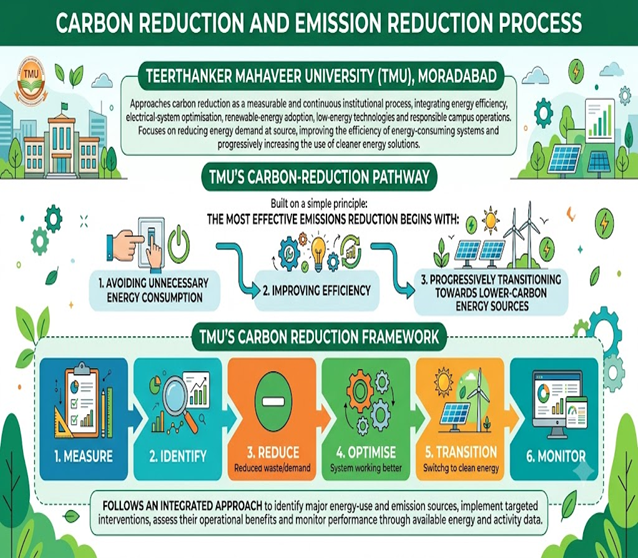
Figure: TMU's Carbon-Reduction Pathway & Integrated Carbon Reduction Framework
Key Carbon-Reduction Initiatives & Impact
The table below provides a consolidated overview of key technical, equipment and operational measures undertaken across the university, highlighting their carbon-reduction actions, measurable institutional outcomes, and strategic contributions to SDG 7:
| Key Initiative | Carbon-Reduction Action | Institutional Impact | Contribution to SDG 7 |
|---|---|---|---|
| Electrical System Optimisation | Upgrading and optimising electrical distribution infrastructure to reduce avoidable transmission and distribution losses | Improved electrical efficiency and lower energy losses | Promotes efficient energy utilisation |
| Energy-Efficient Air Conditioning | Progressive replacement of conventional window ACs with energy-saving inverter-based AC systems | Lower electricity demand during cooling operations | Supports energy efficiency and responsible consumption |
| Efficient Lighting Systems | Replacement of conventional lighting with energy-efficient LED systems | Reduced lighting energy demand and maintenance requirements | Advances efficient use of electricity |
| High-Efficiency Fans | Replacement of older fans with energy-efficient models | Lower electricity consumption across frequently occupied spaces | Reduces energy demand from routine operations |
| Power-Factor Improvement | Use of appropriate power-factor correction measures, including capacitors, where required | Improved power utilisation and reduced electrical losses | Enhances energy-system efficiency |
| Renewable Energy Integration | Expansion and utilisation of renewable-energy solutions where technically and operationally feasible | Supports gradual reduction in dependence on conventional electricity | Accelerates the transition towards cleaner energy |
| Operational Energy Conservation | Awareness, responsible equipment operation, preventive maintenance and energy-conscious practices | Reduces avoidable consumption and supports behavioural change | Promotes sustainable energy use across the campus |
Institutional Impact
Through systematic demand reduction, equipment modernization, and behavioral initiatives, TMU achieves demonstrated institutional outcomes across five core sustainability dimensions:
Carbon Reduction at TMU: A Continuous Improvement Model
TMU moves beyond isolated energy-saving measures towards an integrated carbon-management pathway. The emphasis is on reducing energy demand first, improving system efficiency, adopting cleaner technologies and progressively strengthening renewable-energy integration.
TMU’s Commitment to Clean and Affordable Energy
“The objective is not simply to consume less energy—it is to use energy more intelligently, efficiently and sustainably while creating a measurable pathway towards lower-carbon campus operations.”