




7.2.2 Upgrade Buildings to Higher Energy Efficiency
Building Energy Efficiency: From Passive Design to Measurable Performance
TMU is progressively strengthening the energy performance of its existing buildings through a structured approach that combines daylight optimization, efficient lighting, energy-efficient ventilation, improved electrical systems and performance monitoring. Our building-efficiency strategy is designed around a simple principle: reduce avoidable energy consumption without compromising illumination, occupant comfort, functionality or academic requirements.
1. Daylight Optimization
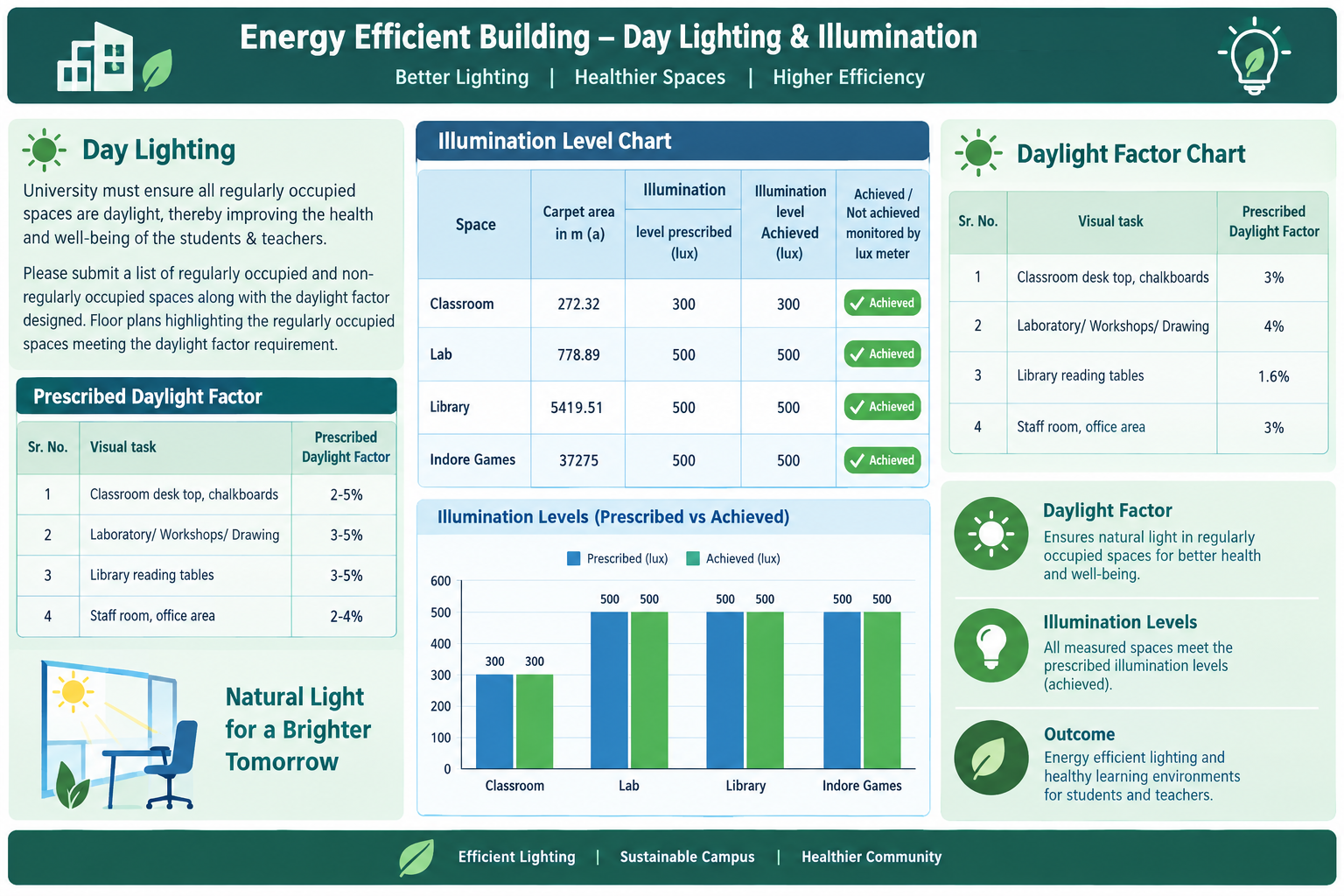
TMU recognizes daylight as a readily available energy resource that can reduce dependence on artificial lighting during suitable operating conditions. Regularly occupied spaces are therefore assessed for daylight availability and illumination adequacy.
Daylight Performance Parameters
| Regularly Occupied Space | Prescribed Daylight Factor |
|---|---|
| Classroom desk top / chalkboard | 2–5% |
| Laboratory / Workshop / Drawing area | 3–5% |
| Library reading tables | 3–5% |
| Staff room / Office area | 2–4% |
Measured Illumination Performance
| Space | Carpet Area (m²) | Prescribed Illumination (lux) | Measured Illumination (lux) | Status |
|---|---|---|---|---|
| Classroom | 272.32 | 300 | 300 | Achieved |
| Laboratory | 778.89 | 500 | 500 | Achieved |
| Library | 5,419.51 | 500 | 500 | Achieved |
| Indoor Games | 37,275 | 500 | 500 | Achieved |
Impact: The measured results demonstrate that required illumination levels can be maintained while the University continues to emphasize appropriate daylight utilization and efficient lighting practices.
2. Energy-Efficient Lighting Systems
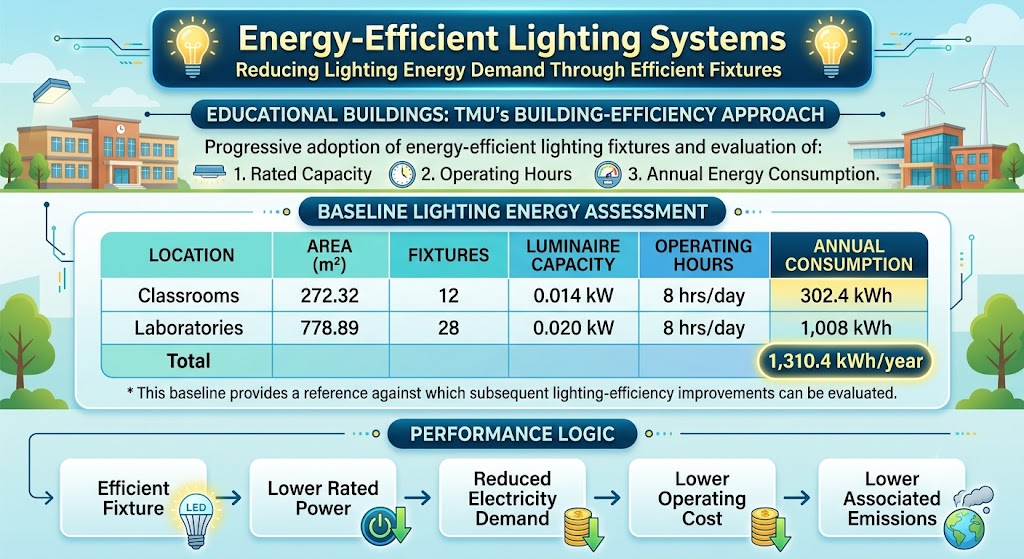
Lighting represents a recurring electricity demand within educational buildings. Our building efficiency approach therefore includes the progressive adoption of energy efficient lighting fixtures and the evaluation of their rated capacity, operating hours and annual energy consumption.
Baseline Lighting Energy Assessment
The supplied assessment provides an annual energy-consumption baseline for selected spaces:
| Location | Area (m²) | Fixtures | Luminaire Capacity | Operating Hours | Annual Consumption |
|---|---|---|---|---|---|
| Classrooms | 272.32 | 12 | 0.014 kW | 8 hrs/day | 302.4 kWh |
| Laboratories | 778.89 | 28 | 0.020 kW | 8 hrs/day | 1,008 kWh |
| Total Annual Baseline Consumption | 1,310.4 kWh/year | ||||
3. Energy-Efficient Ventilation and Fan Systems
TMU is also strengthening building energy efficiency through the adoption of energy-efficient BLDC fans with 5-star Bureau of Energy Efficiency (BEE) ratings.
The intervention contributes to building energy efficiency through:
Lower Electrical Demand
Substantially reduced wattage compared to conventional induction motors.
Improved Efficiency
Certified 5-star BEE performance ensures peak motor efficiency.
Reduced Consumption
Cuts recurring electricity use across lecture halls and hostels.
Lower Associated Carbon Emissions
Directly offsets indirect Scope 2 greenhouse gas emissions from grid power.
Improved Lifecycle Performance
Superior durability, silent operation, and minimized long-term maintenance costs.
4. Energy Saving Solar Panel
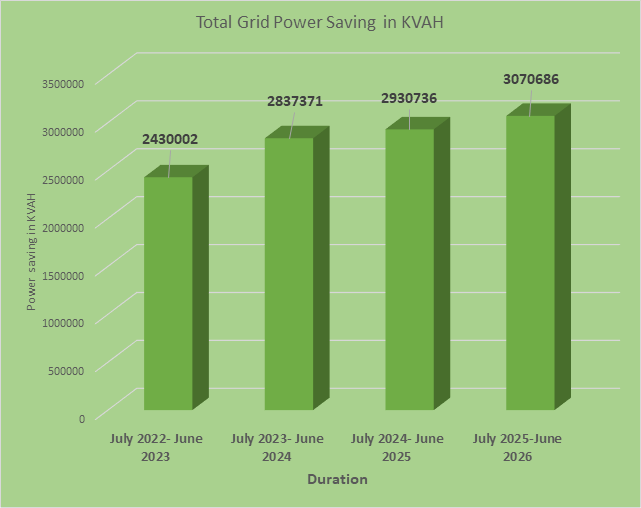
We at TMU are less dependent on conventional sources therefore relying on renewable energy and in the last 5 years, we have increased our renewable energy production. The solar energy played a vital role in energy saving, the data shown below support the TMU commitment toward responsible consumption and production.
Total Grid Power Saving
| Duration | Power Saving in KVAH |
|---|---|
| July 2022– June 2023 | 2,430,002 |
| July 2023– June 2024 | 2,837,371 |
| July 2024– June 2025 | 2,930,736 |
| July 2025–June 2026 | 3,070,686 |
| Cumulative Grid Power Saved (4-Year Total) | 11,268,795 KVAH |
5. Building Electrical-System Efficiency
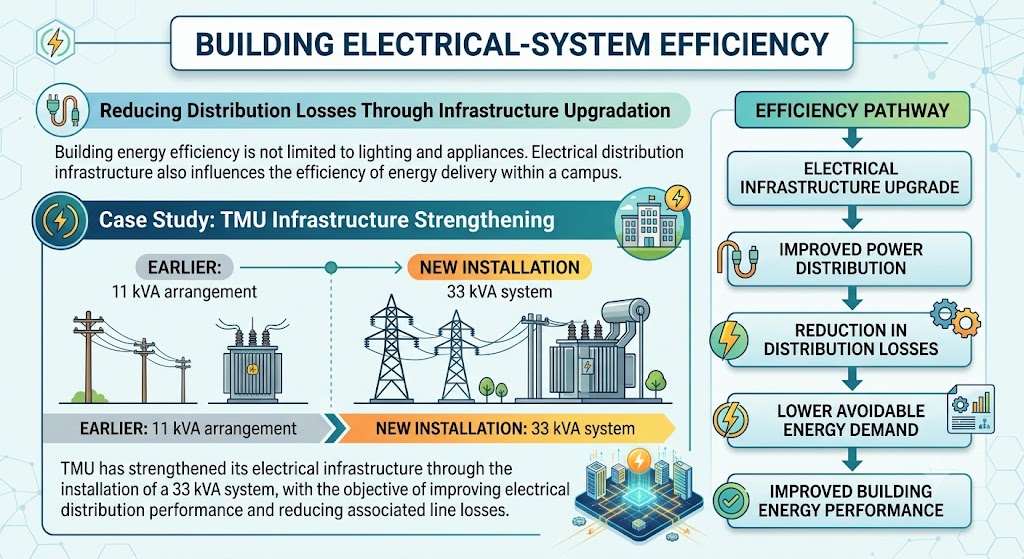
Building energy efficiency is not limited to lighting and appliances. Electrical distribution infrastructure also influences the efficiency of energy delivery within a campus.
TMU has strengthened its electrical infrastructure through the installation of a 33 kVA system in place of the earlier 11 kVA arrangement, with the objective of improving electrical distribution performance and reducing associated line losses.
6. Integrated Building Energy-Efficiency Framework
TMU's approach is evolving from individual equipment replacement toward an integrated building energy-performance framework. The framework combines five intervention areas:
Daylight Optimization
Maximizing natural daylight harvesting through architectural design and window orientation to curb daytime lighting loads.
Efficient Lighting
Systematic deployment of high-lumen, low-wattage LED fixtures across all classrooms, laboratories, and common areas.
Efficient Ventilation
Transition to 5-star BEE rated BLDC fans and natural cross-ventilation principles to reduce thermal cooling demand.
Electrical Infrastructure
High-efficiency 33 kVA substations, high power factor correction (~0.99), and low-loss distribution networks campus-wide.
Monitoring & Verification
Continuous energy auditing, digital sub-metering, and data-driven verification of empirical savings against baselines.
7. Measurement, Verification & Continuous Improvement
A critical component of our building-efficiency strategy is the transition from “equipment installed” to “performance demonstrated.”
Building Energy Performance Parameters & Measurement Purpose
| Performance Parameter | Purpose |
|---|---|
| Daylight factor | Evaluate availability of natural light |
| Illumination level (lux) | Verify visual-performance requirements |
| Fixture wattage | Establish lighting-system efficiency |
| Operating hours | Identify opportunities for operational savings |
| Annual electricity consumption | Quantify energy demand |
| Energy intensity | Compare building performance |
| Verified energy savings | Establish intervention impact |
| Percentage energy reduction | Demonstrate improvement against baseline |
| Avoided emissions | Translate energy savings into climate impact |
8. Institutional Upgrade Plan
TMU strengthens its building-energy performance through a phased programme of assessment, intervention and verification.
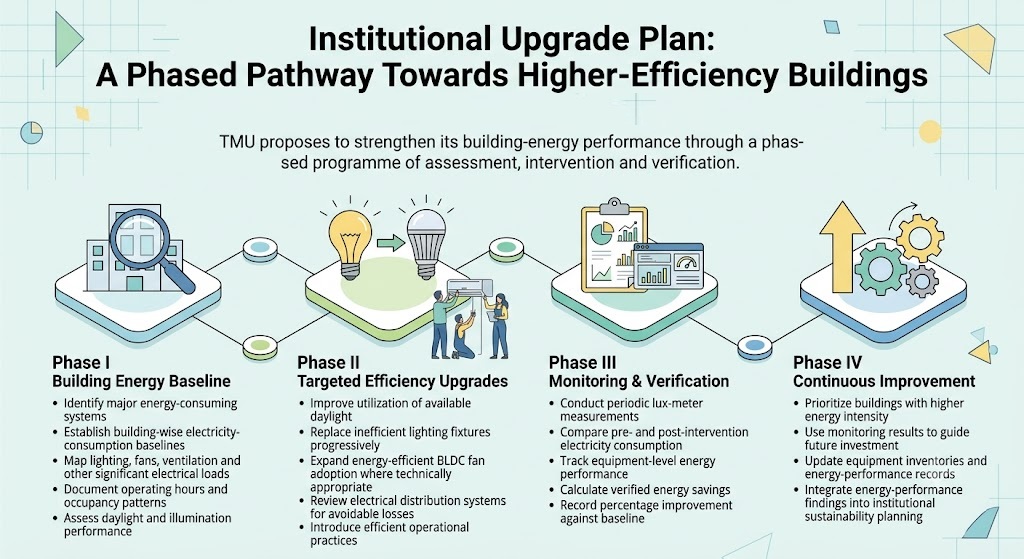
- Identify major energy-consuming systems.
- Establish building-wise electricity-consumption baselines.
- Map lighting, fans, ventilation and other significant electrical loads.
- Document operating hours and occupancy patterns.
- Assess daylight and illumination performance.
- Improve utilization of available daylight.
- Replace inefficient lighting fixtures progressively.
- Expand energy-efficient BLDC fan adoption where technically appropriate.
- Review electrical distribution systems for avoidable losses.
- Introduce efficient operational practices.
- Conduct periodic lux-meter measurements.
- Compare pre- and post-intervention electricity consumption.
- Track equipment-level energy performance.
- Calculate verified energy savings.
- Record percentage improvement against baseline.
- Prioritize buildings with higher energy intensity.
- Use monitoring results to guide future investment.
- Update equipment inventories and energy-performance records.
- Integrate energy-performance findings into institutional sustainability planning.
TMU Energy-Efficient Building Commitment
“TMU is progressively transforming existing buildings into higher-efficiency learning and working environments by integrating daylight optimization, efficient lighting, energy-efficient ventilation, electrical-system improvements and evidence-based performance monitoring.”