




7.4.1 Local Community Outreach for Energy Efficiency
Connecting Energy Literacy, Sustainable Living, and Responsible Resource Consumption Across Communities
We have a strong belief that achieving Affordable and Clean Energy requires energy-conscious practices to extend beyond institutional infrastructure and become part of everyday community life. Accordingly, TMU uses its outreach, awareness and community engagement through National Service Scheme (NSS) unit and other platforms to promote responsible energy use, resource conservation, environmental impact awareness and sustainable lifestyles among students, local communities and other stakeholders.
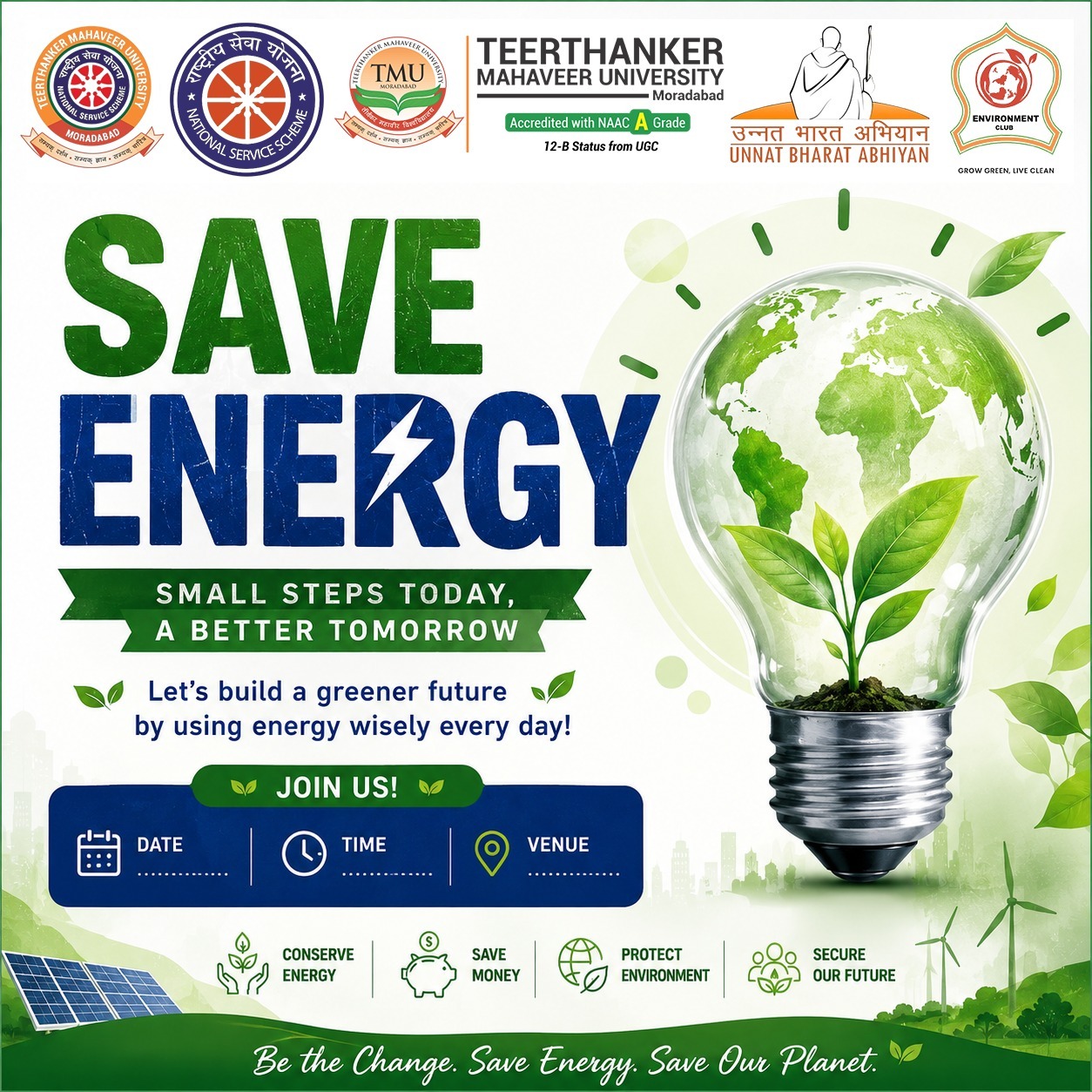
TMU participated in the nationwide pre-campaign for World Environment Day under the Mission LiFE (Lifestyle for Environment) initiative of the Ministry of Environment, Forest and Climate Change (MoEFCC), Government of India. The engagement provided an important platform for communicating the relationship between individual lifestyle choices, resource efficiency and environmental sustainability.
Community Engagement as a Pathway to Energy Efficiency
Energy consumption is influenced not only by technology but also by behaviour, awareness and daily decision-making. Household electricity use, appliance selection, lighting practices, cooling requirements, mobility choices and resource consumption collectively influence energy demand.
TMU therefore promotes an outreach model that connects environmental awareness with practical energy-conscious behaviour. Community-facing activities provide opportunities to communicate core energy-conservation principles:
Electricity Conservation
Avoiding unnecessary electricity consumption across daily domestic and academic routines.
Switch-Off Habit
Switching off lights, fans, computers and appliances when rooms and desks are unoccupied.
Efficient Appliances
Encouraging adoption of star-rated appliances, BLDC fan motors, and LED smart illumination.
Responsible Cooling
Promoting responsible use of cooling equipment with optimal thermostat temperature settings (24°C–26°C).
Renewable Energy Awareness
Educating local stakeholders on the importance, viability, and benefits of solar photovoltaic power.
Nature & Energy Harmony
Connecting broader environmental protection and green cover directly with heat moderation and energy saving.
Mission LiFE: Connecting Lifestyle Choices with Energy Conservation
TMU’s participation in the Mission LiFE-oriented nationwide pre-campaign for World Environment Day reflects the University’s effort to connect sustainability principles with individual and community behaviour. The Mission LiFE framework provides an opportunity to communicate how relatively simple choices—such as reducing unnecessary energy consumption, using resources efficiently and adopting environmentally responsible habits—can collectively contribute to a more sustainable society.
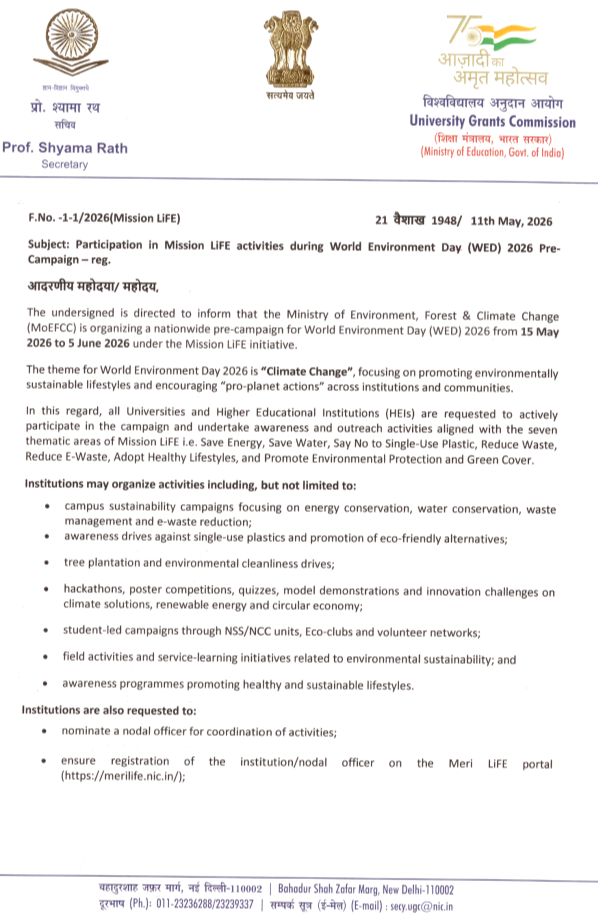
UGC Mission LiFE Advisory
Ministry of Environment, Forest and Climate Change (MoEFCC) Pre-Campaign Directive
Connecting Lifestyle Choices with Energy Conservation
Five-Stage Pathway: Awareness → Behavioural Change → Resource Efficiency → Reduced Energy Demand → Environmental Benefits
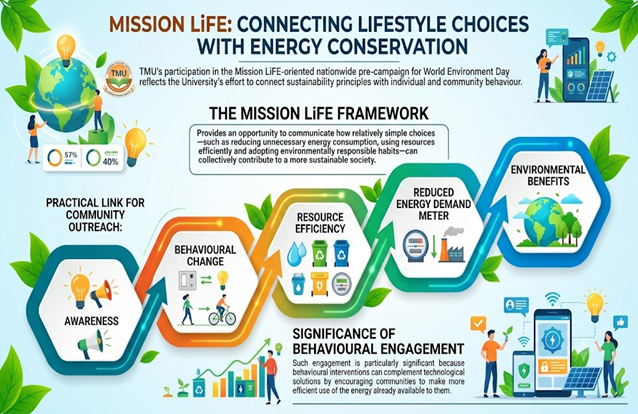
Figure: Practical Link for Community Outreach under Mission LiFE
Tree Plantation: Nature-Based Support for Energy Conservation
Greener Communities, Cooler Spaces, Lower Cooling Demand
TMU’s Tree Plantation Drives form part of its broader environmental sustainability outreach. Although plantation activities are primarily ecological interventions, strategically planned green cover can also support energy-conscious campus and community environments through shade provision, microclimate moderation and reduction of direct heat exposure.
Trees planted around buildings, pathways and activity areas can provide natural shade and contribute to more comfortable outdoor environments. By moderating local heat conditions, vegetation can complement other energy-efficiency measures, particularly in warm climatic conditions where cooling requirements can contribute substantially to electricity demand.
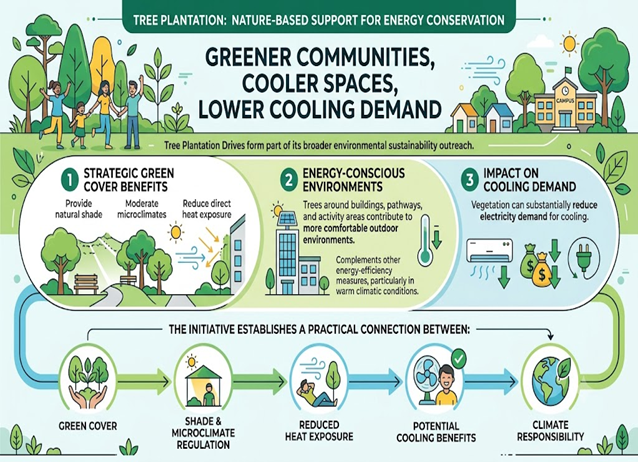
Figure: Strategic Green Cover Pathway from Tree Planting to Lower Cooling Demand
World Environment Day 2025: Community-Oriented Environmental Action
On the occasion of World Environment Day 2025, Teerthanker Mahaveer University (TMU), Moradabad, organised a Tree Plantation Programme under the National Service Scheme (NSS).
The programme aimed to strengthen environmental consciousness, encourage ecological responsibility and contribute to a greener institutional environment. By involving students and members of the university community in practical environmental action, the initiative transformed sustainability awareness into visible participation.
The activities contribute indirectly to energy-efficiency awareness by demonstrating the relationship between green infrastructure, climate resilience, environmental responsibility and resource-conscious living. More importantly, such activities provide a platform through which sustainability messages can reach participants beyond the immediate activity itself, encouraging the wider adoption of environmentally responsible practices.
From Outreach Activities to Measurable Sustainability Outcomes
Our community outreach approach can be understood through an impact-oriented framework rather than simply through the number of activities conducted.
| Outreach Dimension | Key Initiative | Energy-Efficiency Relevance | Intended Community Impact |
|---|---|---|---|
| Awareness | Mission LiFE / World Environment Day engagement | Promotes understanding of responsible resource and energy use | Greater awareness of energy-conscious lifestyles |
| Behaviour | Sustainability-oriented outreach | Encourages reduction of unnecessary energy consumption | More responsible day-to-day energy practices |
| Environmental Action | Tree Plantation Drives | Supports shading and local microclimate regulation | Greener and more climate-responsive surroundings |
| Youth Engagement | NSS-led environmental activities | Builds sustainability consciousness among young participants | Development of environmentally responsible citizens |
| Community Participation | Participatory sustainability activities | Converts environmental messaging into practical engagement | Stronger community ownership of sustainability |
| Sustainable Lifestyle | Mission LiFE-oriented communication | Links individual choices with resource efficiency | Wider adoption of low-resource and responsible practices |
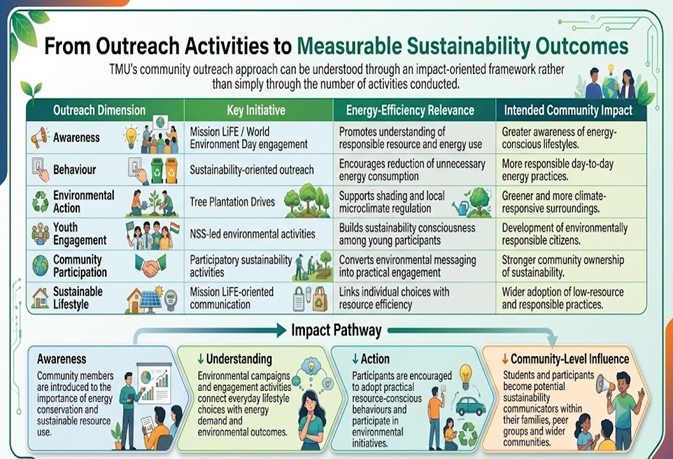
Figure: Four-Tier Impact Pathway (Awareness → Understanding → Action → Community-Level Influence)
TMU's Contribution at a Glance
The outreach approach supports the broader transition towards responsible energy consumption, improved energy-efficiency awareness and sustainable lifestyles.
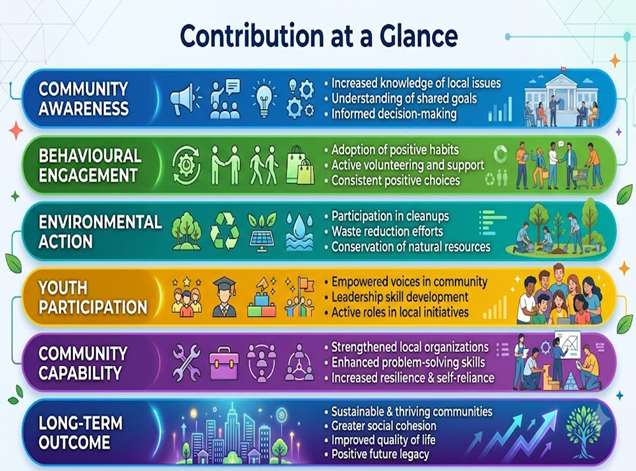
Figure: Multi-Dimensional Community Impact Model for SDG 7 Outreach
Building an Energy-Conscious Community
TMU views local outreach as an important complement to technological and infrastructure-based energy-efficiency interventions. While efficient equipment, renewable-energy systems and energy-management practices can reduce institutional energy demand, long-term sustainability also depends on people understanding why efficient energy use matters and how they can contribute.
Through environmental campaigns, Mission LiFE engagement, NSS activities, plantation drives and sustainability-oriented community programmes, TMU seeks to develop a culture in which energy conservation becomes part of responsible citizenship rather than an isolated institutional practice.
The University's outreach philosophy moves from “awareness of sustainability” to “participation in sustainability”, creating opportunities for students and community stakeholders to become active contributors to energy-conscious development.