



2.4.1 Proportion of Graduates in Agriculture
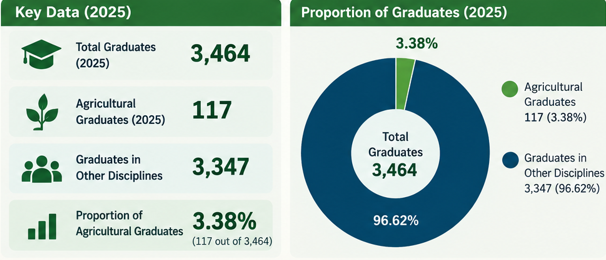
Teerthanker Mahaveer University (TMU) offers agricultural education through programmes that prepare students in crop production, agronomy, soil science, and agricultural resource management. These programmes provide students with academic knowledge and practical exposure relevant to agricultural development and the responsible use of natural resources. For the reporting period, TMU recorded a total of 3,464 graduates, of whom 117 graduated in agriculture.
Agricultural graduates therefore represented approximately 3.38% of the University's total graduating population. This indicator presents the proportion of graduates completing agricultural studies and reflects the place of agricultural education within TMU’s overall academic provision. The University's agriculture programmes are relevant to SDG-02, Zero Hunger, through their focus on agricultural knowledge and practices associated with food production and agricultural sustainability.
Total University Graduates
Agricultural Graduates
Proportion in Agriculture
Graduate Distribution & Academic Indicators
The chart below illustrates the proportion of agricultural graduates relative to the total graduating cohort, showcasing TMU’s strategic role in training specialized professionals for national food security:
Core Competencies of Agriculture Graduates at TMU
The College of Agriculture Sciences equips students with field-tested competence across modern agricultural sciences:
Agronomy & Soil Science
Mastery of crop physiology, integrated nutrient management, precision irrigation, and soil fertility conservation.
Plant Protection & IPM
Biological pest management, eco-friendly disease control, and minimisation of hazardous chemical agrochemicals.
Climate-Smart Farming
Drought-resistant crop varieties, millets promotion, carbon-smart agronomic practices, and agroforestry systems.
Agri-Extension & RAWE
Rural Agricultural Work Experience (RAWE) embedding students in village farm communities for direct lab-to-land technology transfer.