



2.2.1 Campus Food Waste Tracking
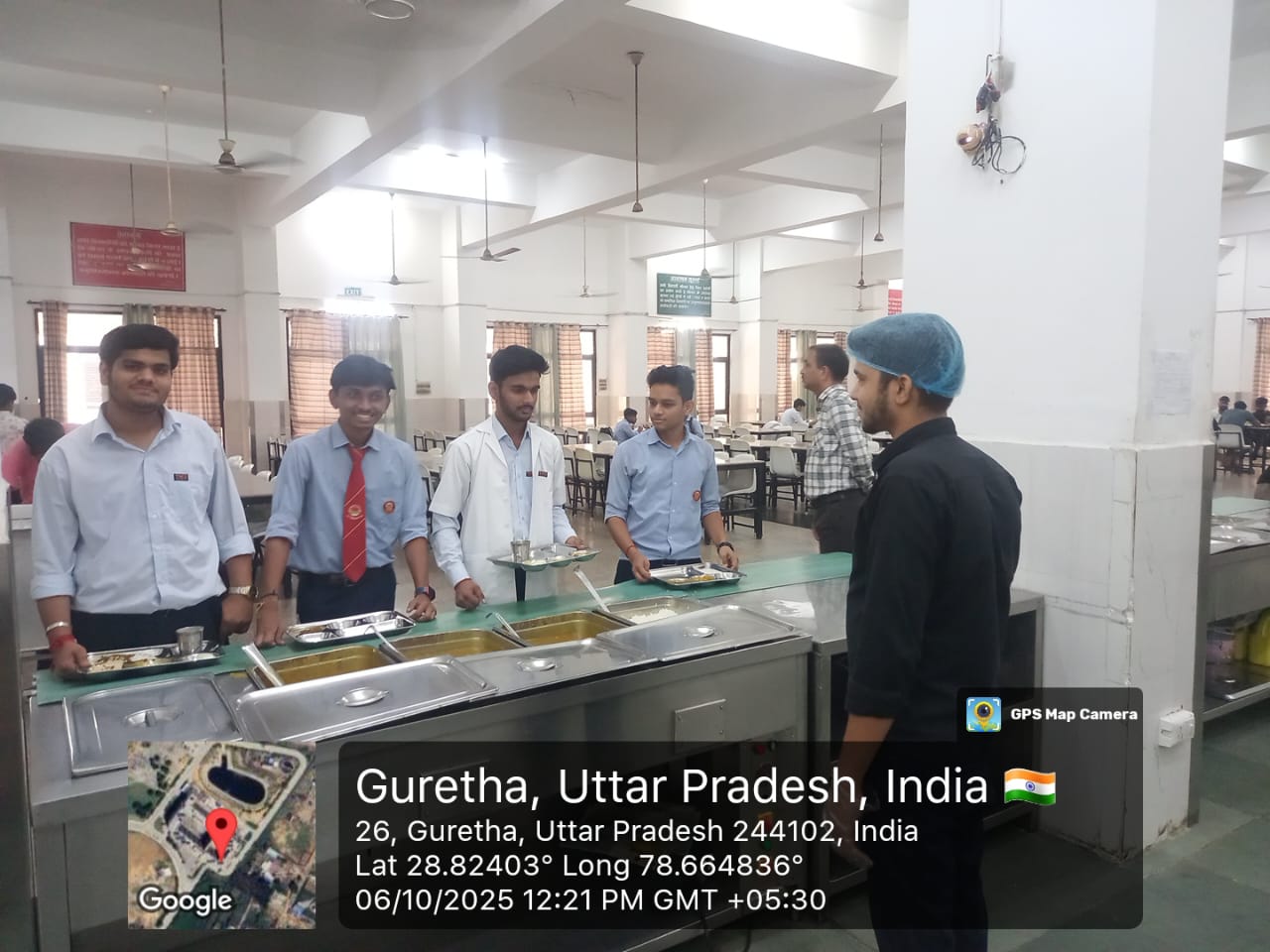
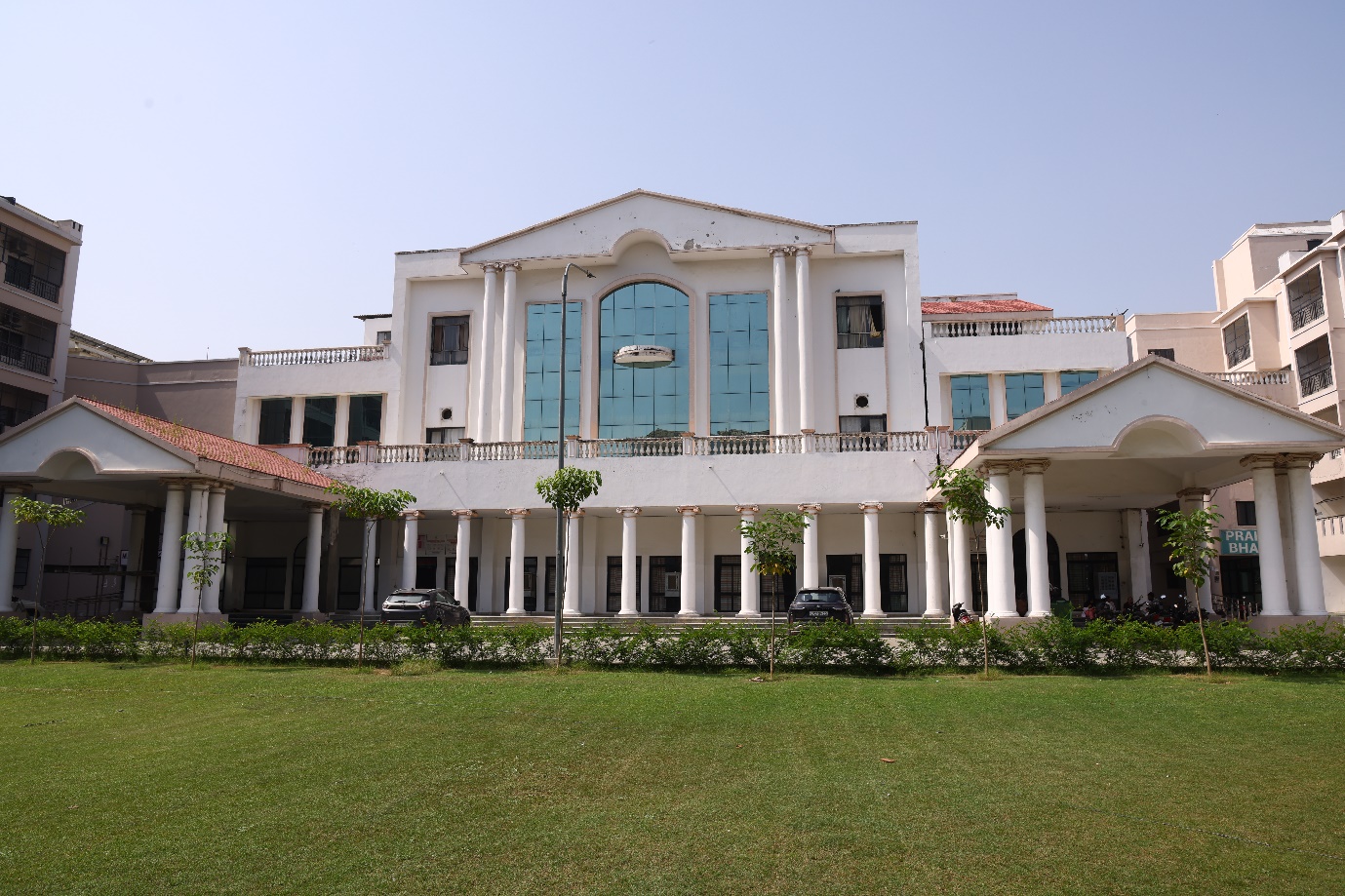
The University maintains an institutional mechanism for the management of food waste generated through its campus food-service facilities. Food waste generated from campus messes and canteens is collected daily as part of the University's waste-management practices. We maintain waste-management documentation, demonstrating the continuity of food-waste management practices across academic years. This system provides an institutional mechanism for the regular collection and appropriate handling of biodegradable food waste generated from campus dining operations.
As part of the existing practice, biodegradable food waste generated from messes and canteens is channelled to nearby piggery farms, providing a productive route for the utilisation of food waste rather than treating it solely as conventional waste. The practice contributes to our broader institutional waste-management initiatives. The University's approach combines regular food-waste collection, institutional documentation and resource recovery, thereby supporting responsible food consumption and reducing the quantity of biodegradable food waste requiring conventional disposal.
New Initiative of Data-Driven Food Waste Tracking & Prevention System
We have strengthened the institutional approach to food-waste prevention through the development of a digital mess monitoring and food-consumption tracking application. The system captures real-time information on meal bookings, actual meal attendance and cancelled meals across university hostel messes. This enables the university to understand the actual demand for food at individual messes and for different meal periods, thereby providing a data-based basis for planning food preparation and reducing unnecessary food production.
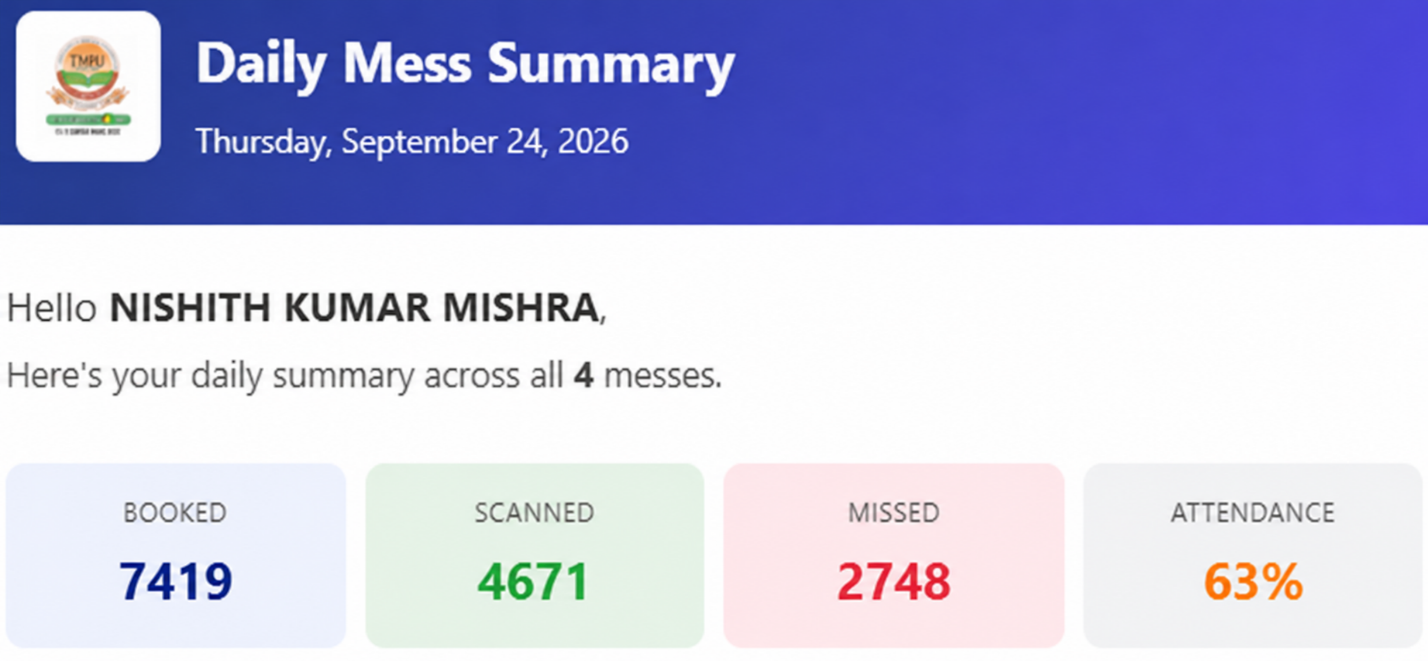
The Daily Mess Summary generated through the TMU Dashboard (App) demonstrates that the system currently monitors multiple hostel messes and records meal-wise data for breakfast, lunch, snacks and dinner. For each meal, the system records the number of normal bookings, instant/other bookings, guests, scanned entries and missed meals. It also calculates attendance percentages for individual meals and provides a consolidated daily summary.
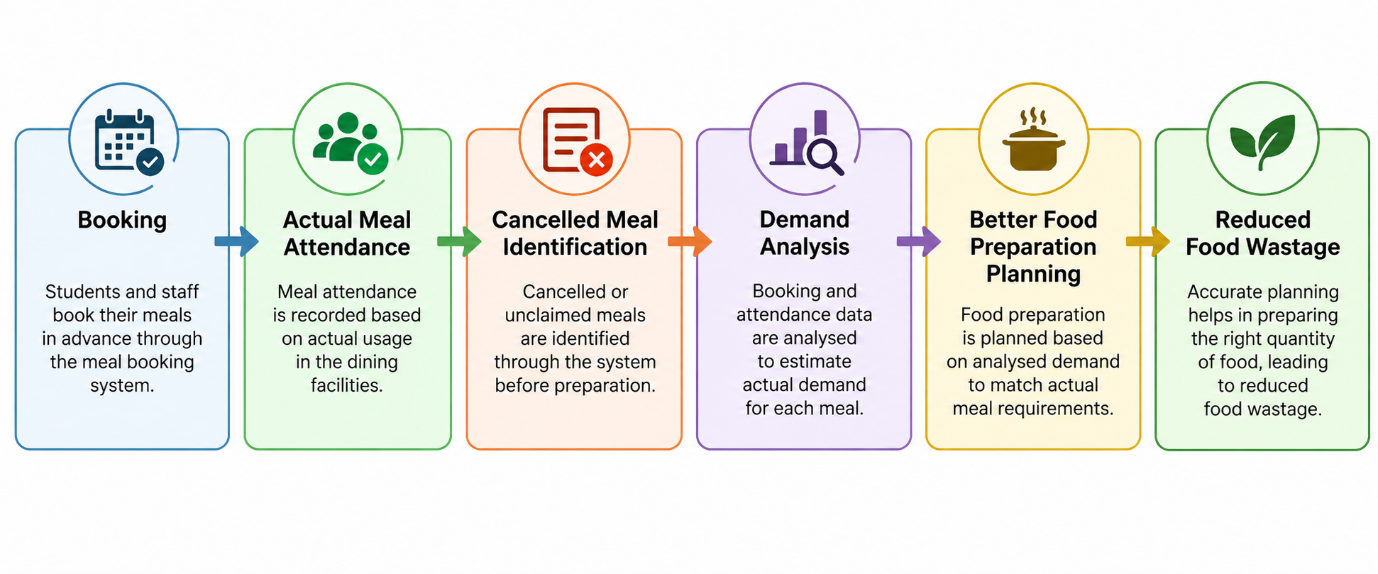
TMU Food-Tracking App Flow
01. Meal Booking
Students indicate their expected meal requirement through the digital system. The application therefore provides the mess administration with an indication of the expected number of meals before food preparation. The report demonstrates that the system distinguishes between different categories of bookings, including Normal, Instant and Guest entries. It also separately identifies Auto Bookings, which are noted in the report as being applicable to Medical-PG students.
02. Actual Meal Attendance
When students actually attend the mess, their meal access is recorded through the system as "Scanned". This creates an important distinction between:
Instead of relying only on hostel population or historical assumptions, we can identify how many students actually came for a particular meal. For example, on 24 September 2026, the consolidated report across the four messes recorded:
Booked Meals
Scanned Entries
Cancelled Meals
Overall Attendance
03. Identification of Cancelled Meals
One of the most important features from a food-waste prevention perspective is the separate recording of "Cancelled" meals. The system therefore identifies the difference between the number of meals expected/booked and the number of students who actually attended. These records enable us to identify meal-wise and mess-wise variations in demand rather than treating every meal as having the same consumption pattern.
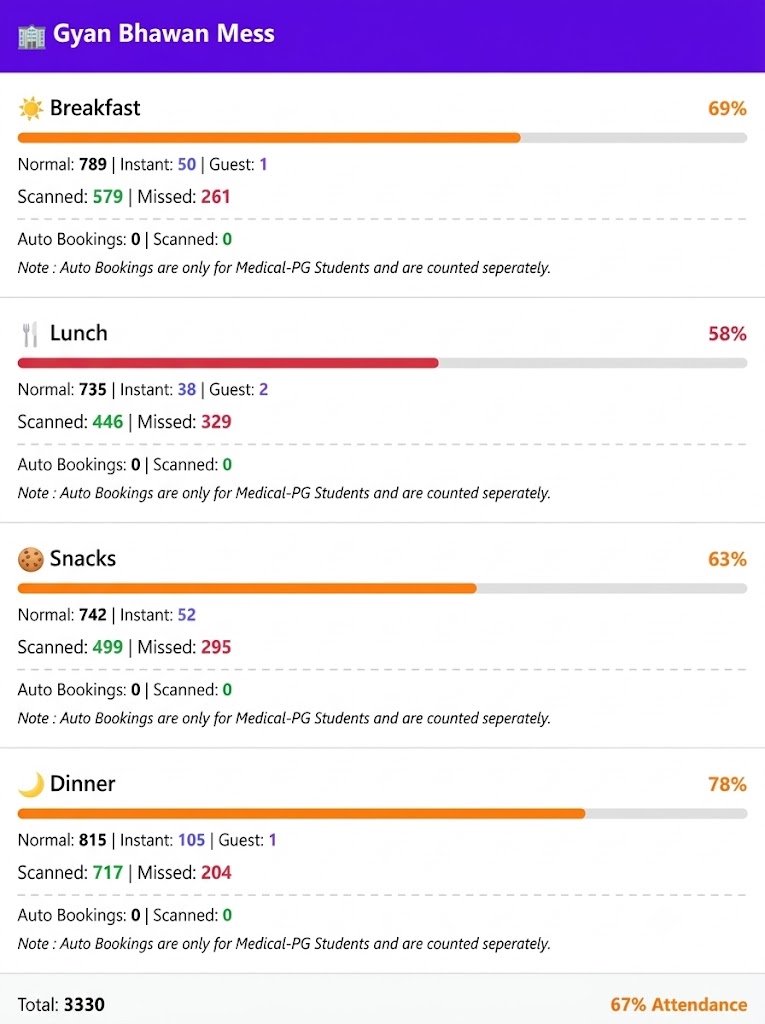
Total: 3,330 | 67% Attendance
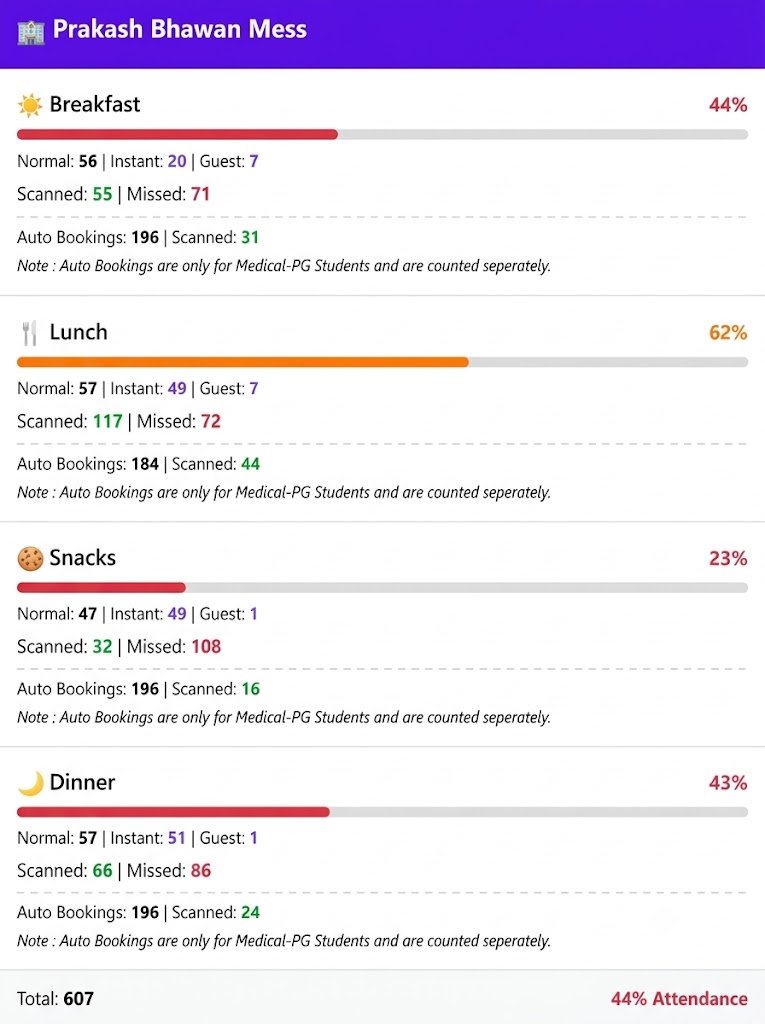
Total: 607 | 44% Attendance
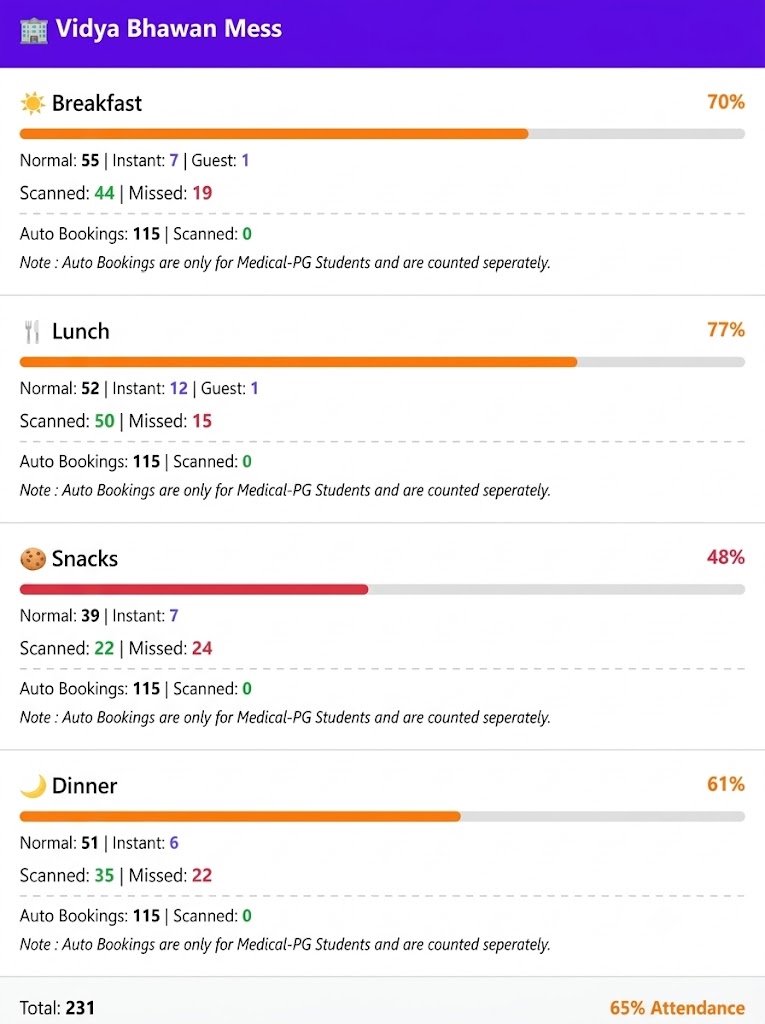
Total: 231 | 65% Attendance
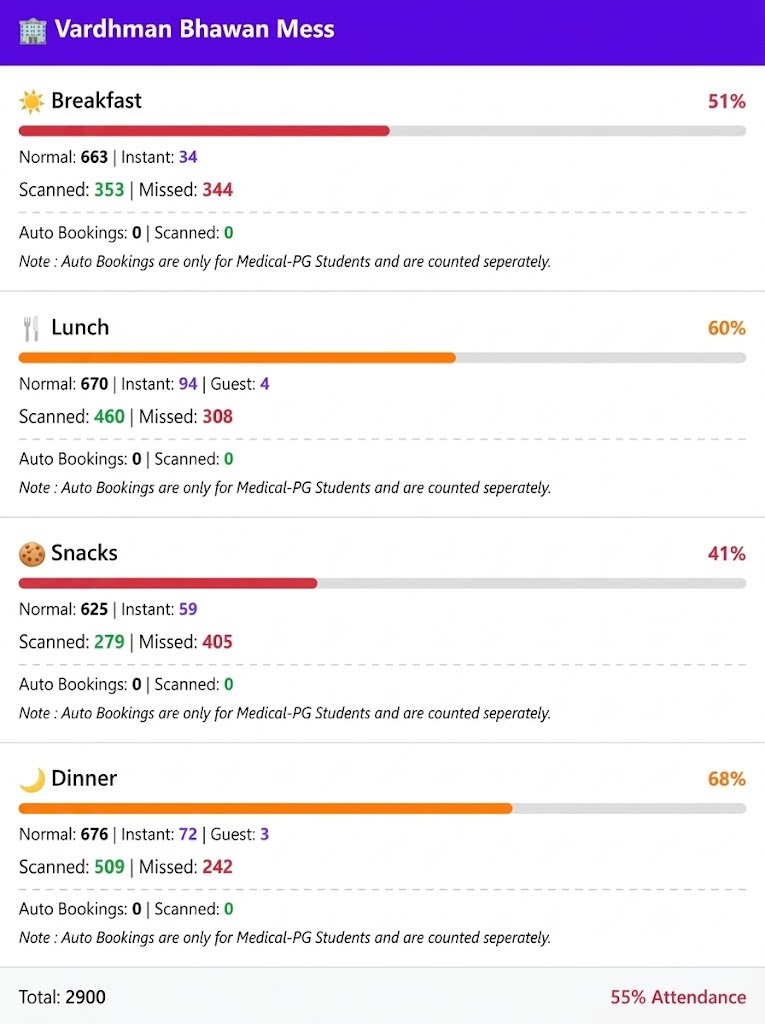
Total: 2,900 | 55% Attendance
The details of 4 meals starting with breakfast to dinner of Gyan Bhawan Mess is given below to understand meal-level differences on a particular day. This helps in knowing the actual consumption each day across all mess in the Campus.
| Meal | Booked / Expected | Scanned | Cancelled | Attendance |
|---|---|---|---|---|
| Breakfast | 840 | 579 | 261 | 69% |
| Lunch | 775 | 446 | 329 | 58% |
| Snacks | 794 | 499 | 295 | 63% |
| Dinner | 921 | 717 | 204 | 78% |
04. Meal-Wise Demand Analysis
The application provides attendance percentages for each meal and each mess. This is particularly important because food demand is not uniform throughout the day. The above tabular data shows the actual consumption of respective meals by the students and the percentage of food wastage prevented through the app. This type of information can help mess management understand where food demand is consistently high and where preparation quantities may need adjustment.
05. From Attendance Data to Food-Waste Reduction
The major institutional value of the application is that it enables food preparation to increasingly reflect actual consumption patterns. The operational logic is:
Higher actual demand → appropriate food preparation quantity
Lower actual demand → opportunity to reduce preparation quantity
Identify recurring demand mismatch → modify future preparation planning
Thus, the application can help reduce the possibility of preparing the same quantity of food every day irrespective of actual student attendance. This transforms food management from a largely fixed-quantity model into a data-informed demand-based model.
06. Four-Mess Institutional Monitoring
The report demonstrates that the system is not limited to a single hostel. The Daily Mess Summary covers multiple TMU hostel messes as under:
- Gyan Bhawan Mess
- Vardhman Bhawan Mess
- Vidya Bhawan Mess
- Prakash Bhawan Mess
The TMU food boking app, therefore provides the ability to compare food demand across different residential facilities in the campus to identify meal-specific variations. This is significant for institutional-scale food-waste management because the university can identify where demand is high, where it is low and where preparation patterns require adjustment.
07. Automated Daily Reporting
The important feature is that the information is consolidated into an automated Daily Mess Summary. The report is generated from the “TMU Dashboard” and provides an institutional summary of meal bookings, scans, cancelled meals and attendance. The report is explicitly identified as an automated daily summary from the TMU Dashboard. This creates a recurring monitoring mechanism rather than a one-time assessment.
08. Strategic Food-Waste Prevention Cycle at TMU
BOOKING
Students indicate expected meal requirements.
SCANNING
Actual attendance is recorded when students access the mess.
CANCELLED-MEAL ANALYSIS
The system identifies booked/expected meals that will not be consumed.
DEMAND PATTERN IDENTIFICATION
TMU identifies meal-wise and mess-wise attendance patterns.
FOOD PREPARATION OPTIMISATION
Mess operations can use recurring demand patterns to better align preparation quantities with expected consumption.
FOOD-WASTE PREVENTION
Reduced mismatch between food prepared and food required can help minimize avoidable food wastage.
CONTINUOUS MONITORING
Daily reports provide feedback for further improvement.