




12.2.7: Disposable Policy: Extensions to Services
Institutional Extension of Disposable Minimisation to Outsourced Services, Vendors, and Supply Chains
Teerthanker Mahaveer University (TMU) extends its Disposable Policy beyond its directly managed operations to encompass outsourced services, third-party service providers, contractors, vendors, and the wider supply chain. This comprehensive scope ensures that responsible consumption and waste prevention are embedded throughout the institution’s operational and procurement ecosystem, rather than being limited to activities undertaken by its own personnel.
All outsourced service providers and relevant supply-chain partners are aligned in their activities with the principles and requirements of the policy concerning the responsible use of disposable products, the avoidance of unnecessary single-use materials, waste segregation, and environmentally responsible disposal. These aligned activities apply, as relevant to the nature of the service, to catering and food services, housekeeping, facility management, maintenance, events, logistics, packaging, and the procurement and delivery of goods.
The policy promotes the consideration of reusable, recyclable, and lower-impact alternatives wherever operationally feasible, hygienically appropriate, and consistent with applicable legal and safety requirements. Supply-chain responsibility is an integral component of policy implementation, expecting procurement and service-delivery decisions to account for the environmental implications of products supplied, their packaging, consumption during service delivery, and the management of resulting waste.
Key Initiatives in Service & Supply-Chain Extension
| S. No. | Key Initiative | Scope of Implementation |
|---|---|---|
| 1 | Extension to Outsourced Services | Extending disposable material reduction requirements to outsourced housekeeping, catering, facility management, event management, and other applicable contracted services. |
| 2 | Sustainable Procurement Practices | Encouraging procurement teams and suppliers to prioritize reusable, recyclable, and environmentally preferable alternatives to avoidable single-use products. |
| 3 | Supplier & Vendor Engagement | Communicating the policy’s sustainability expectations to vendors, contractors, and relevant supply-chain partners to promote consistent environmental practices. |
| 4 | Reduction of Disposable Packaging | Encouraging suppliers to minimize unnecessary packaging, excess wrapping, and disposable materials associated with deliveries and service operations. |
| 5 | Responsible Waste Management | Promoting waste segregation, reuse where feasible, and appropriate disposal practices across outsourced operations and procurement-related activities. |
Institutional Extension Framework Diagrams
Documented implementation of policy extensions across vendor operations and third-party campus services
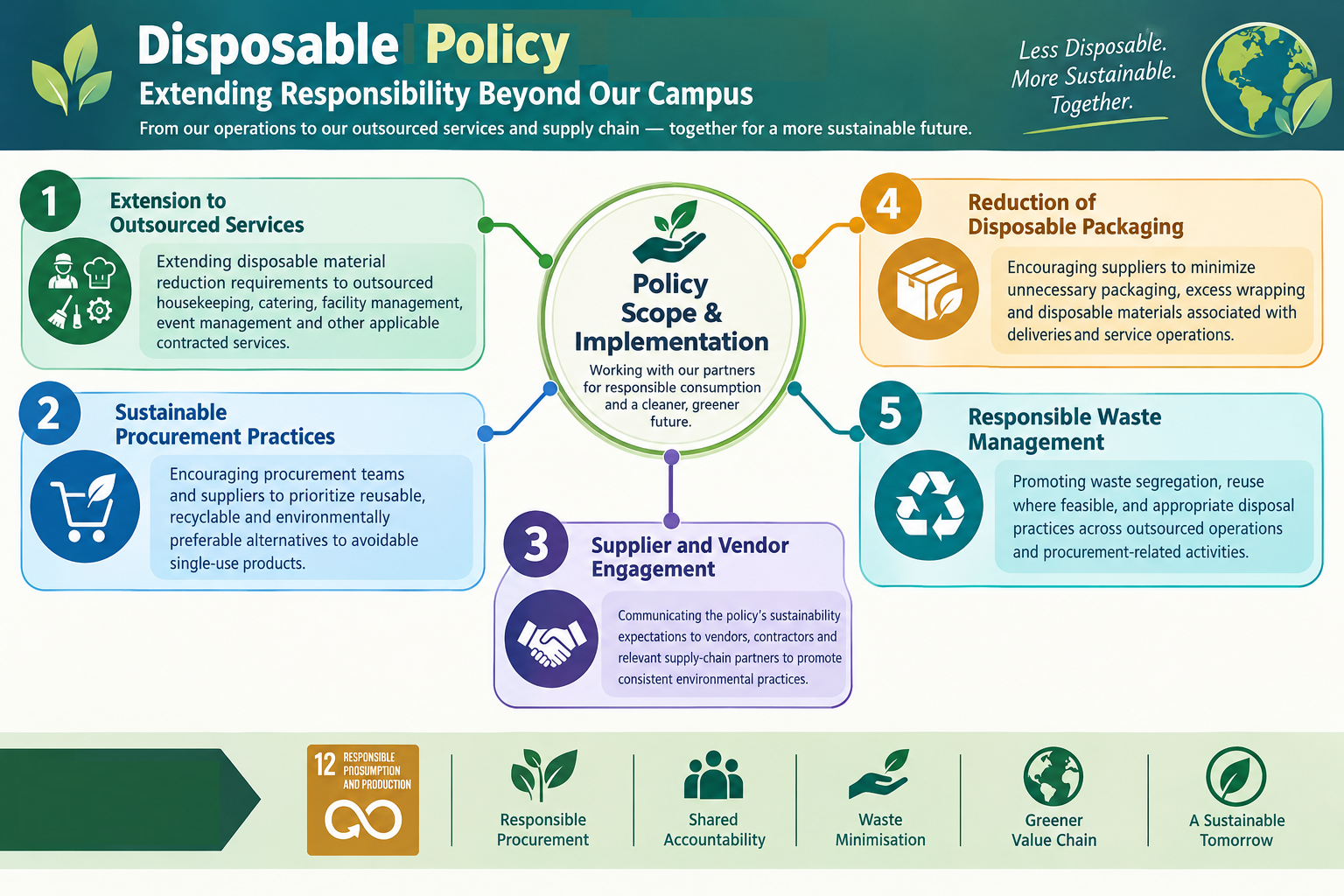
Service Extension Operational Matrix
Embedding green compliance into contractor and supplier contracts.
Packaging & Delivery Protocols
Minimising secondary packaging and ensuring recyclable material delivery.
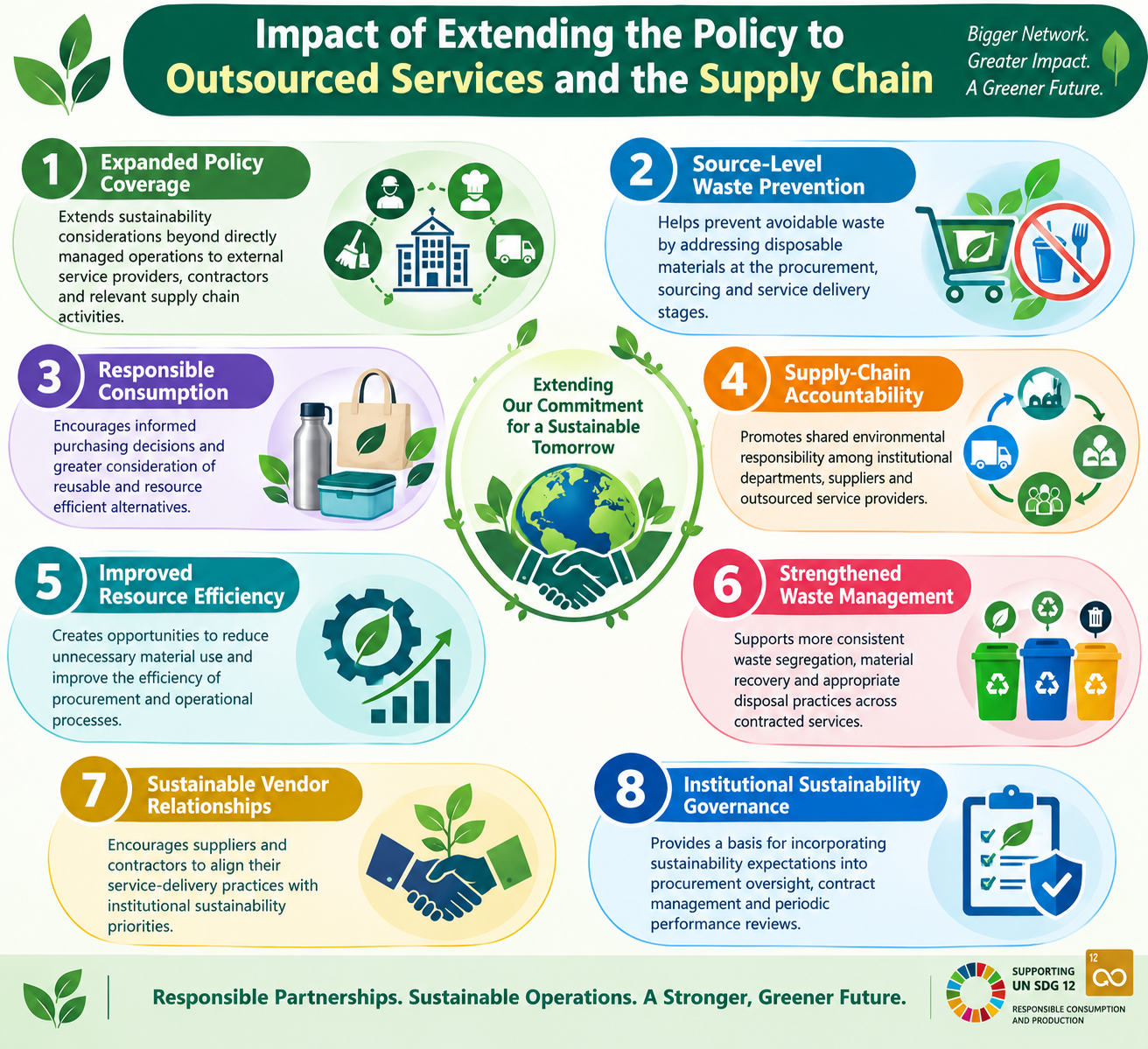
Impact of Extending the Policy to Outsourced Services & the Supply Chain
| Sr. No. | Impact Dimension | Expected Institutional Impact |
|---|---|---|
| 1 | Expanded Policy Coverage | Extends sustainability considerations beyond directly managed operations to external service providers, contractors, and relevant supply chain activities. |
| 2 | Source-Level Waste Prevention | Helps prevent avoidable waste by addressing disposable materials at the procurement, sourcing, and service delivery stages. |
| 3 | Responsible Consumption | Encourages informed purchasing decisions and greater consideration of reusable and resource-efficient alternatives. |
| 4 | Supply-Chain Accountability | Promotes shared environmental responsibility among institutional departments, suppliers, and outsourced service providers. |
| 5 | Improved Resource Efficiency | Creates opportunities to reduce unnecessary material use and improve the efficiency of procurement and operational processes. |
| 6 | Strengthened Waste Management | Supports more consistent waste segregation, material recovery, and appropriate disposal practices across contracted services. |
| 7 | Sustainable Vendor Relationships | Encourages suppliers and contractors to align their service-delivery practices with institutional sustainability priorities. |
| 8 | Institutional Sustainability Governance | Provides a basis for incorporating sustainability expectations into procurement oversight, contract management, and periodic performance reviews. |
Waste Management Policy
Formal institutional policy extending waste minimization, source segregation, and responsible disposal requirements to all outsourced service providers, contractors, and supply-chain partners.
View PDFShared Supply-Chain Responsibility
By holding external contractors, dining concessionaires, and logistics partners to stringent sustainability benchmarks, Teerthanker Mahaveer University ensures that circular economy practices extend through its entire ecosystem, fostering regional accountability and driving progress toward UN Sustainable Development Goal 12.