




Simulation Laboratory
Overview of Simulation Laboratory
The Simulation Laboratory in the Nursing College is a modern teaching and learning facility designed to provide students with hands-on clinical experience in a safe and controlled environment. The lab helps students develop knowledge, clinical competence, communication skills, critical thinking, and confidence before providing care to real patients in hospital settings.
The laboratory replicates real hospital and community healthcare environments, enabling students to practice various nursing procedures, emergency management, maternal and child health care, and patient assessment techniques through simulation-based learning.
The Simulation Lab supports undergraduate, postgraduate, and continuing nursing education programs by integrating theory with practical application.
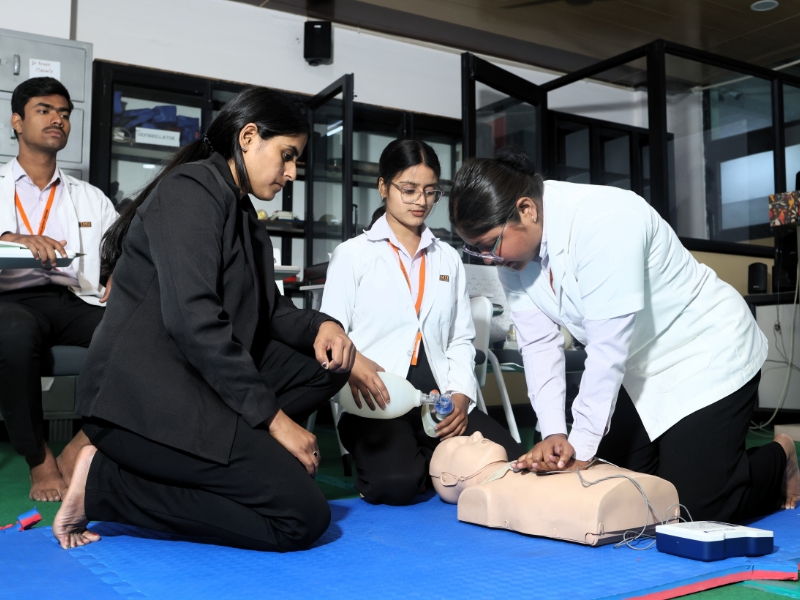
Key Features and Equipment
High-fidelity and low-fidelity patient simulators
Advanced simulators for practicing realistic patient scenarios and developing clinical decision-making skills.
Adult, pediatric, neonatal, and obstetrical mannequins
Diverse range of mannequins allowing specialized training across different age groups and care settings.
CPR and Basic Life Support (BLS) manikins
Dedicated manikins for mastering essential life-saving techniques and emergency response protocols.
Injection and IV cannulation training arms
Anatomically accurate models for safely practicing intravenous access and medication administration.
Delivery and newborn care models
Specialized models for obstetrical training, childbirth simulations, and essential neonatal care.
Hospital beds with bedside units
Fully equipped simulated patient units replicating real ward environments for comprehensive care practice.
Oxygen administration and suction apparatus
Standard respiratory care equipment for training in airway management and oxygen therapy.
Defibrillator and emergency crash cart
Fully stocked emergency carts for hands-on practice in code blue and critical care scenarios.
Vital signs monitoring equipment
Modern diagnostic tools for accurate measurement and continuous monitoring of patient vitals.
Audio-visual teaching system and demonstration area
Integrated AV technology enabling clear procedure demonstrations and debriefing sessions.
Nursing procedure trays and sterile dressing sets
Comprehensive sterile kits for practicing aseptic techniques and wound care protocols.
Personal protective equipment (PPE) and infection control supplies
Standard safety gear ensuring students master proper infection prevention and control measures.
Lab Functionality and Use
| Sl. No. | Functionality | Description |
|---|---|---|
| 01 | Procedure Demonstration | Demonstration and return demonstration of nursing procedures. |
| 02 | Competency Training | Skill training and competency assessment. |
| 03 | Clinical Simulation | Clinical simulation scenarios and case-based learning. |
| 04 | Emergency Care Practice | Practice of emergency and critical care procedures. |
| 05 | Maternal & Child Health | Maternal and child health nursing procedures. |
| 06 | Teamwork Training | Communication and teamwork training. |
| 07 | OSCE Assessments | Objective Structured Clinical Examination (OSCE). |
| 08 | BLS Training | Basic Life Support (BLS) and emergency response practice. |
| 09 | Pre-clinical Preparation | Pre-clinical preparation before hospital postings. |
Other Important Information
- The Simulation Laboratory follows strict infection control and safety protocols.
- Students must wear proper clinical uniform and maintain discipline inside the lab.
- All equipment and mannequins should be handled carefully to ensure longevity and effective utilization.
- Regular maintenance and updating of equipment are carried out to meet current nursing education standards.
- The lab promotes competency-based nursing education in accordance with university and professional council guidelines.