



BSc Forensic Science Course Details, Full Form, Eligibility, Fees, Colleges, Jobs
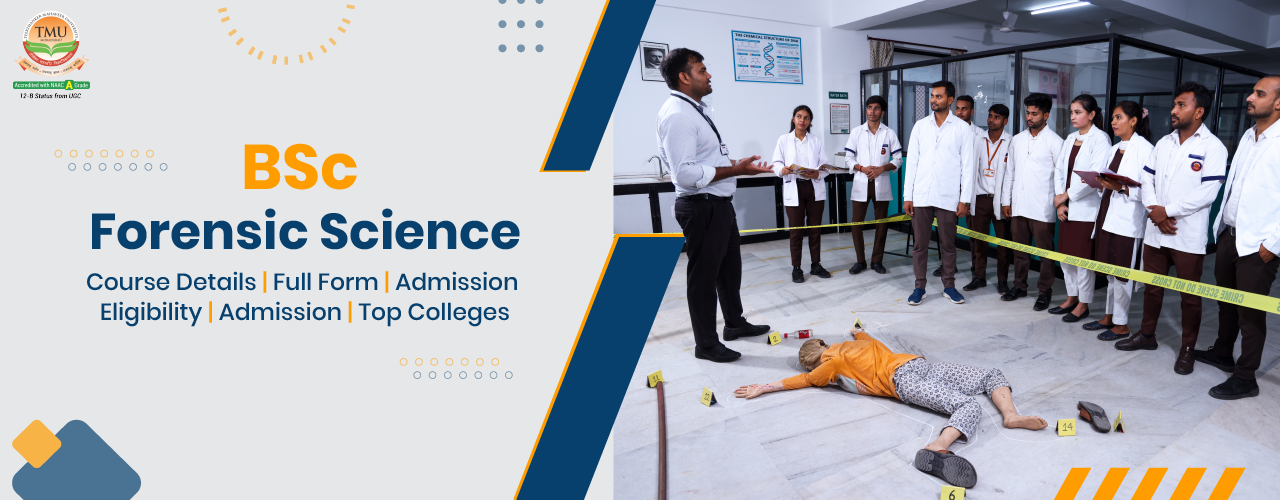
Table of Contents
Bachelor of Forensic Science is a degree course. It is concerned with the use of science to address crimes. The course normally lasts three years. It is subdivided into six semesters. However, in a few universities that have additional research- or internship-based opportunities, it can be four years.
To qualify, you have to complete secondary education. You have to have a certain percentage of marks (normally 50 to 60 percent). A scientific background is also required. It must incorporate subjects such as physics, chemistry, and biology/mathematics. Entrance exams frequently require admission. These are the Joint Entrance Examination (JEE). Otherwise, there is the National Eligibility cum Entrance Test (NEET) and the university-specific tests.
Q: Who is a Forensic Scientist?
A forensic scientist is a scientist who uses his or her knowledge and expertise to examine crime scenes and investigative evidence. They apply scientific procedures to analyze physical evidence such as blood, hair, fingerprints or digital evidence to aid in solving crimes and legal prosecution.
Their role is/was as follows:
Analyse Evidence: They carefully review the evidence at the crime scene, an accident, or even a suspicious matter.
Scientific Techniques: They employ several scientific methods such as DNA analysis, fingerprint mapping, toxicology tests or digital forensics to derive valuable information out of the evidence.
Findings Interpretation: They assess the findings of their interpretation and render them in understandable and succinct reports to law enforcement and legal departments.
Expert Witness: There are also instances where they can be summoned to give evidence in court as expert witnesses of what they have discovered and know.
On the whole, forensic scientists are very important in the criminal justice system as they are able to offer objective and scientific evidence on how to solve a crime, identify the culprits and acquit those who are innocent.
Full Form of BSc Forensic Science
BSc Forensic Science means Bachelor of Science in Forensic Science. This undergraduate degree course deals with the use of scientific principles and methods in crime investigation, evidence analysis and in the support of the judicial system
Teerthanker Mahaveer University
Apply for Admission
Apply for Admission
BSc Forensic Science Course Details
Overview:The Bachelor of Science in Forensic Science is an undergraduate degree designed to provide students with an understanding of the principles and practices used in crime scene investigation, evidence analysis, and the application of scientific methods to support legal investigations.
Duration:Typically, the course lasts three to four years, depending on the institution.
Core Subjects:
- Introduction to Forensic Science
- Criminal Law and Procedure
- Crime Scene Investigation
- Forensic Biology
- Forensic Chemistry
- Forensic Physics.
- Digital Forensics
- Forensic Anthropology
- Forensic Toxicology
- Forensic Psychology
Elective Subjects:
- Environmental Forensics
- Forensic Entomology
- Forensic Odontology
- Forensic Accounting
- Cybersecurity
Laboratory Work:Hands-on training in laboratories to develop practical skills in evidence collection and analysis.
BSc Forensic Science Syllabus
| Year | Courses | Focus |
| 1 | Intro to Forensics, Basic Chemistry, Biology, Law, Crime Scene Investigation | Foundation |
| 2 | Forensic Biology, Chemistry, Physics, Digital Forensics, Anthropology | Intermediate Techniques |
| 3 | Toxicology, Psychology, Advanced Crime Scene, Research Methods, Project | Advanced Analysis & Research |
| Electives | Environmental, Entomology, Odontology, Accounting, Cybersecurity | Specialized Skills |
| Lab Work & Internship | Hands-on experience | Practical Application |
| Skills Developed | Analytical thinking, Problem-solving, Scientific proficiency, Communication | Core Skills |
Forensic Science Specialisation
Forensic science specialisation involves focusing on a specific area within the field, providing in-depth knowledge and skills in that domain. This enhances career prospects and expertise
| Specialisation | Focus | Career Path |
| Forensic Biology | DNA analysis, blood spatter analysis, serology | DNA analyst, forensic biologist |
| Forensic Chemistry | Chemical analysis of substances like drugs, explosives, toxins | Forensic chemist, toxicologist |
| Digital Forensics | Examination of digital devices and electronic data | Digital forensic investigator, cybersecurity analyst |
| Forensic Anthropology | Analysis of human skeletal remains | Forensic anthropologist, medico-legal investigator |
| Forensic Toxicology | Detection and analysis of drugs, alcohol, and poisons in biological samples | Forensic toxicologist, laboratory manager |
| Forensic Odontology | Dental evidence analysis | Forensic odontologist, dental consultant |
| Forensic Psychology | Psychological aspects of criminal behaviour | Forensic psychologist, criminal profiler |
| Environmental Forensics | Analysis of environmental samples for pollution and contamination | Environmental forensic scientist, environmental consultant |
BSc Forensic Science Eligibility
To pursue a BSc in Forensic Science in India, typically, the eligibility criteria include:
- Educational Qualifications: Candidates must have completed higher secondary education (Class 12) with a science stream (Physics, Chemistry, and Biology/Mathematics) from a recognised board like CBSE, ISC, or equivalent.
- Minimum Marks: Generally, a minimum aggregate score of 50-60% in the qualifying examination is required, although this can vary between institutions.
- Entrance Exams: Some universities and colleges may require candidates to pass entrance exams specific to Forensic Science or accept scores from national-level exams like JEE, NEET, or state-level CETs.
- Age Limit: There is usually no specific age limit for admission, but some institutions may have age criteria.
- Additional Requirements: Certain institutions might have additional requirements such as proficiency in English, aptitude tests, or interviews.
BSc Forensic Science Entrance Exams
Several entrance exams in India are commonly accepted for admission to BSc Forensic Science courses. Here are some of the prominent ones:
- JEE Main (Joint Entrance Examination Main): Conducted by the National Testing Agency (NTA), this exam is primarily for engineering admissions but is also accepted by some institutes for BSc Forensic Science.
- NEET (National Eligibility cum Entrance Test): Though primarily for medical courses, NEET scores are accepted by some universities for BSc Forensic Science.
- CUET (Common University Entrance Test): Conducted by NTA, this exam is used by many central and state universities for undergraduate admissions, including BSc Forensic Science.
- State-Level CETs (Common Entrance Tests): Various states in India conduct their own CETs for admissions to undergraduate courses. Examples include MH CET, KCET, and WBJEE.
- Entrance exams specific to universities:Some universities conduct their own entrance exams. Notable examples include:
- All India Forensic Science Entrance Test (AIFSET): Specifically for BSc Forensic Science admissions.
- Jamia Millia Islamia Entrance Exam: For admissions to their forensic science course.
- Delhi University Entrance Test (DUET): For various undergraduate courses, including forensic science.
BSc Forensic Science Admission Process
The admission process for BSc Forensic Science in India typically involves the following steps:
- Eligibility: Pass Class 12 (India) Science with Physics, Chemistry, Biology, English (check minimum marks for each).
- Entrance Exams:
- National (possible): CUET (Science focus)
- University Specific (possible): Individual forensic science entrance exams
- Selection: Merit-based (grades + entrance exam) or Merit + Interview
Prepare by:
- Check the university websites for specific requirements.
- Strengthening science subjects in Class 12.
- Preparing for entrance exams (if required).
- Developing critical thinking, problem-solving, observation, and communication skills.
Bonus Tip: Look for programs with labs and internships.
forensic science colleges in india
There are several well-regarded government colleges in India offering BSc Forensic Science programs. Here are a few to consider:
| College Name | Location |
| Institute of Criminology and Forensic Science of Lok Nayak Jayaprakash Narayan (LNJN NICFS) | New Delhi |
| Dr. Bhim Rao Ambedkar University (Central University) | Agra |
| University of Madras | Chennai |
| Punjabi University | Patiala |
| Osmania University | Hyderabad |
Remember, this is not an exhaustive list, and other government colleges may offer excellent BSc Forensic Science programs. Researching and comparing different options is crucial to finding the best fit for your needs and interests.Teerthanker Mahaveer University also offer BSc Forensic Science course however, the university is a private organisation.
Forensic science scholarships
Finding scholarships specifically for forensic science in India can be challenging. Here's why and what you can do:
Forensic science is a growing field, but scholarship programs dedicated solely to it might be limited. However, there are scholarships for science programs in general that you can leverage.
- Government Scholarships:Explore scholarship programs offered by the central and state governments in India. These might be based on merit, caste, or economic background and can be applied towards forensic science degrees. Search for terms like "Government of India Scholarships" or "[State Name] Scholarships. "
- University Scholarships:Many universities offering forensic science programs might have their own scholarship programs. Check the websites of particular universities you're interested in for scholarship opportunities.
- Science Scholarships:Look for scholarships for general science programs like chemistry, biology, or natural sciences. These can be applied towards a forensic science degree as well.
Tips for Increasing Scholarship Chances:
- Maintain b Academics:High academic performance increases your competitiveness for scholarships.
- Highlight Achievements:Showcase awards, research projects, or extracurricular activities related to science or forensics in your scholarship applications.
- Financial Need:If applicable, demonstrate financial need to strengthen your scholarship application.
- Meet Deadlines:Apply for scholarships well before the deadlines to increase your chances of selection.
By following these steps, you can increase your chances of finding scholarships to support your forensic science education in India.
BSc Forensic Science Course Fees
The cost of a BSc Forensic Science program in India can vary significantly depending on several factors:
- College Type:Government colleges generally have lower fees compared to private universities.
- College Location:Institutions in metropolitan cities might have higher fees than those in smaller towns.
- Program Reputation:Prestigious colleges might command higher fees due to their reputation and perceived program quality.
Here's a breakdown of the expected fee range:
- Minimum:₹30,000 per year
- Maximum:₹2.5 Lakhs per year (private universities)
BSc Forensic Science Fees in TMU
| Course | Specialisation | Fees and Duration |
| BSc | Forensic Science | 31,500/ sem | 3 years |
| MSc | Forensic Science | 30,600/sem | 2 years |
Why Choose TMU for BSc Forensic Science
The right university is always the key, and Teerthanker Mahaveer University (TMU) is one of the best options to study BSc Forensic Science. TMU has a good academic background, state-of-the-art infrastructure and a student-centric educational system.
TMU also has the best forensic laboratories with sophisticated instruments that enable students to have practical experience at the initial stage. The curriculum will be structured to the industry standard and trends in forensic science. The seasoned faculty staff offer an ideal combination of both academic and practical exposure, hence the provision of complete learning to students.
The emphasis on career development is the other thing that makes TMU special. Seminars, frequent workshops, industrial visits, and internships enable students to learn about real-life forensic issues. The university also offers good placement services and helps the students to seek opportunities in forensic laboratories, law enforcement and research centres.
In TMU, students do not simply graduate, but they develop a career with confidence, competence, and clarity. In case you are serious about forensic science, the atmosphere at TMU provides an opportunity that satisfies your passion.
BSc Forensic Science Jobs
A BSc Forensic Science degree opens doors to exciting career opportunities in various fields. Here's a breakdown of some potential job roles and their work environments:
| Job Title | Work Environment | Description |
| Forensic Scientist (Government Laboratories) | Government forensic laboratories | Analyze evidence for criminal investigations. |
| Crime Scene Investigator (Police Departments) | Crime scenes | Collect and process evidence at crime scenes, working with law enforcement. |
| Forensic Expert (Central Bureau of Investigation/Intelligence Bureau) | Investigative agencies | Assist agencies in specific areas like fingerprint analysis, ballistics, or toxicology. |
| Forensic Analyst (Private Laboratories) | Private laboratories | Conduct forensic analysis for legal firms, insurance companies, or private investigators. |
| Research Associate (Research Institutions) | Research institutions | Contribute to research and development in forensic science fields. |
| Forensic Consultant | Independent practice or consulting firms | Provide expert advice and analysis on forensic evidence to legal teams or private clients. |
| Forensic Photographer | Crime scenes and laboratories | Specialize in capturing crime scene photographs for evidence documentation. |
| Fingerprint Examiner | Forensic laboratories | Analyze fingerprints for identification purposes in criminal investigations. |
| Toxicologist | Forensic laboratories | Analyze biological samples to detect the presence of drugs or poisons. |
BSc Forensic Science Salary
The salary for a BSc Forensic Science graduate in India can vary depending on several factors:
Experience: Salaries increase with experience. Freshers can expect a lower starting salary compared to someone with several years under their belt.
Location: Salaries are higher in metropolitan cities than in smaller towns.
Employer: Government jobs generally offer lower salaries but better job security, while private companies might offer higher starting salaries but with less stability.
Here's a breakdown of the typical salary range:
Freshers: ₹3.5 Lakhs - ₹5 Lakhs per annum (This is an estimated range and may vary)
Experienced Professionals (5+ years): ₹6 Lakhs - ₹10 Lakhs per annum (This is an estimated range and may vary)
Tips for Higher Salaries:
- Gain experience through internships or research opportunities.
- Pursue higher qualifications (MSc, Ph.D.) in specialized areas.
- Develop strong analytical, communication, and teamwork skills.
- Consider specializing in a particular forensic science field.
How to Become a Forensic Scientist?
Become a Forensic Scientist:
- Education:
- Complete high school (Science focus: Physics, Chemistry, Biology, Math)
- Earn a BSc in Forensic Science (3-4 years)
- Admission:
- Meet minimum marks in science subjects (50-60% typically)
- Pass entrance exams (CUET, university-specific)
- Develop Skills:
- Analytical thinking
- Attention to detail
- Scientific proficiency
- Communication skills
- Gain Experience:
- Forensic lab/police internships
- Optional (Further Specialization):
- Master's degree (MSc) in specific forensic area
- Ph.D. for research or teaching
- Career Paths:
- Government labs (analyze evidence)
- Crime scene investigation (police)
- Investigative agencies (CBI/IB)
- Private forensic labs
- Research institutions
- Forensic consulting
Conclusion
The BSc Forensic Science course is a comprehensive undergraduate degree that equips students with scientific and analytical skills to solve crimes and support the legal system. Spanning three to four years, the course covers a diverse range of subjects from Forensic Biology and Chemistry to Digital Forensics and Forensic Psychology. Eligibility typically requires a science background in secondary education, and admission often involves entrance exams like JEE, NEET, or CUET.
Career prospects for graduates are promising, with roles in government laboratories, crime scene investigation, private forensic labs, and research institutions. Starting salaries range from ₹3.5 Lakhs to ₹5 Lakhs per annum for freshers, with potential growth as experience and expertise increase.
Overall, a BSc in Forensic Science offers a robust foundation for those interested in a scientific approach to crime-solving, with ample opportunities for specialization and career advancement
FAQs
Q1: What is the scope of B.Sc forensic science?
Ans:B.Sc. Forensic Science opens doors to jobs in crime scene investigation, labs & more. Analyze evidence, specialize in areas like fingerprints, and earn up to ₹5 Lakhs starting out. It's a springboard for a rewarding career in forensics.
Q2: Is B.Sc forensic a good career?
Ans:B.Sc. Forensic Science is a good choice for science lovers who enjoy puzzles and justice. Analyze evidence, solve crimes, and potentially make a big difference. It can be demanding but offers diverse careers and intellectual challenges..
Q3: What is the salary of B.Sc forensic?
Ans:The starting salary for a B.Sc. Forensic Science graduate in India typically ranges from ₹3.5 Lakhs to ₹5 Lakhs per annum. This is an estimate and can vary depending on factors like experience, location, and the employer (government vs private)..
Q4: Is B.Sc forensic hard to study?
Ans:B.Sc. Forensic Science can be tough with science courses and needing a keen eye for detail. But if you love solving mysteries and applying science, it's rewarding. b study habits and passion for forensics will help you succeed..
Q5: Is CUET compulsory for forensic science?
Ans:CUET for Forensic Science depends on the university. It's new, so some universities may have their own exams. Always check the specific university’s website or admissions office for details..
This content gives an overview of the programme and is for educational purposes only. For updated admission guidelines and counselling support, please connect with our Counsellor Team.