



Data Science Course: Eligibility, Syllabus, Careers and Specialisations
Table of Contents
Data Science course is the study of collecting, analysing and interpreting large amounts of data to extract meaningful information. It is the combination of mathematics, statistics, computer science, and source-specific knowledge. It helps organisations to predict future outcomes and solve complex problems.
What is Data Science?
Data science is an interdisciplinary science involving the extraction of meaning from large quantities of data using:
- Programming
- Statistics
- Machine learning
- Business knowledge
Basic components of Data Science are:
- Data Collection and Processing
- Exploratory Data Analysis
- Predictive Modeling
- Data Visualization
- Machine Learning and AI techniques.
Healthcare, finance, e-commerce, education, and manufacturing are some of the industries that engage in data science significantly.
Teerthanker Mahaveer University
Apply for Admission
Apply for Admission
Why is Data Science Important?
Data science has become an important tool in today's information-rich world. Its importance stems from its ability to:
- Uncover Hidden Patterns: Data scientists can identify trends and patterns that are not immediately apparent to the human eye.
- Make Informed Decisions: By analysing data, organisations can make evidence-based decisions that drive growth and efficiency.
- Improve Efficiency: Data science can optimise processes, reduce costs, and improve overall productivity.
- Personalise Experiences: Companies can use data science to tailor products and services to individual customers.
- Drive Innovation: Data science can fuel innovation by uncovering new opportunities and insights.
Data Science Course Details
| Data Course Title | Key Topics Covered | Tools / Technologies |
| Introduction to Data Science | Data basics, statistics, data types | Excel, basic Python/R |
| Python for Data Science | Python syntax, data structures, libraries | Python, Jupyter Notebook |
| Statistics & Probability | Descriptive & inferential statistics | Python/R (pandas, scipy) |
| Data Analysis & Visualisation | Data cleaning, charts, dashboards | Python (pandas, matplotlib), Tableau, Power BI |
| Machine Learning Fundamentals | Regression, classification, clustering | Python (scikit-learn) |
| Big Data & SQL | Databases, SQL queries, big data concepts | SQL, Hadoop, Spark |
| Advanced Machine Learning / AI | Deep learning, neural networks | TensorFlow, Keras, PyTorch |
| Capstone Project | Real-world data projects & case studies | All learned tools |
Data Science Eligibility Criteria
The eligibility criteria for data science programmes can vary slightly depending on the institution and the level of education you're pursuing. However, here are some common requirements:
| Program Level | Educational Qualification | Minimum Percentage | Entrance Exams (if applicable) |
| Undergraduate (BSc, BTech) | 12th standard (Science stream preferred) | 50% (varies by institution) | State-level entrance exams, university-specific entrance exams |
| Postgraduate (MS, MTech) | Bachelor’s degree in a relevant field (Computer Science, Mathematics, Statistics, etc.) | 50% (varies by institution) | CAT, GMAT, GRE, or university-specific entrance exams |
Additional Requirements:
- Quantitative Aptitude: Strong mathematical and analytical skills are essential.
- Programming Skills: Proficiency in programming languages like Python or R is often preferred.
- Problem-solving: Ability to analyse complex problems and find solutions.
- Communication Skills: Effective communication and presentation skills are valuable.
- Domain Knowledge: Experience or knowledge in a specific industry (e.g., finance, healthcare) can be beneficial.
Data Science Course Syllabus Details
Undergraduate Level (BSc / BTech in Data Science)
| Semester / Area | Syllabus Topics |
| Fundamentals of Data Science | Introduction to data science, data types, data lifecycle, applications |
| Mathematics for Data Science | Linear algebra, probability, statistics basics |
| Programming Basics | Python fundamentals, control structures, functions |
| Data Structures & Algorithms | Arrays, lists, stacks, queues, basic algorithms |
| Database Management | SQL, relational databases, data modelling |
| Data Analysis | Cleaning of data, data wrangling, and exploratory data analysis |
| Data Visualization | Charts, dashboards, storytelling with data |
| Machine Learning Basics | Supervised & unsupervised learning, regression, classification |
| Big Data Fundamentals | Hadoop, Spark basics, data processing |
| Project / Internship | Mini project, industry exposure |
Postgraduate Level (MSc / MTech in Data Science)
| Semester / Area | Syllabus Topics |
| Advanced Statistics & Mathematics | Probability distributions, hypothesis testing |
| Advanced Programming | Advanced Python, R programming |
| Machine Learning | Decision trees, SVM, ensemble methods |
| Deep Learning | Neural networks, CNN, RNN |
| Big Data Analytics | Hadoop ecosystem, Spark, NoSQL |
| Data Engineering | Data pipelines, ETL, cloud basics |
| AI & Advanced Analytics | Natural language processing, computer vision |
| Data Security & Ethics | Data privacy, governance, ethical AI |
| Research Methodology | Research design, data-driven research |
| Dissertation / Capstone Project | Industry or research-based project |
Tools & Technologies Covered
- Python, R
- SQL
- Tableau / Power BI
- Hadoop, Spark
- TensorFlow, PyTorch
Data Science Course Specialisations
- Machine Learning – Designing algorithms that learn from data and make predictions.
- Artificial Intelligence – Building intelligent systems that mimic human decision-making.
- Big Data Analytics – Analysing and processing extremely large and complex datasets.
- Data Analytics – Interpreting data to identify trends, patterns, and insights.
- Business Analytics – Using data to support strategic business decisions.
- Deep Learning – Applying neural networks to solve complex problems like image and speech recognition.
- Statistical Data Science – Using statistical methods to analyse and model data.
- Natural Language Processing (NLP) – Enabling machines to understand and process human language.
- Computer Vision – Analysing images and videos to extract meaningful information.
Career Opportunities After Data Science
| Job Role | Key Responsibilities | Industries |
| Data Scientist | Build predictive models, analyse complex datasets | IT, Finance, Healthcare, Education |
| Data Analyst | Analyse data, create reports and dashboards | Business, Marketing, E-commerce |
| Machine Learning Engineer | Develop and deploy ML models | Technology, AI startups |
| Data Engineer | Design and manage data pipelines | IT, Cloud services |
| Business Analyst | Convert data insights into business strategies | Consulting, Corporate sector |
| AI Engineer | Develop AI-based solutions and applications | AI, Robotics, Automation |
| Big Data Analyst | Handle and analyse large-scale datasets | Telecom, Banking |
| Statistician | Apply statistical methods to interpret data | Research, Government |
| Database Administrator | Manage and optimise databases | IT, Enterprises |
| Data Visualisation Specialist | Present data insights using visual tools | Media, Marketing, Corporate firms |
Salary Breakdown
| Experience Level | Average Salary (INR) | Average Salary (USD) |
| Entry-Level (0–2 years) | ₹4,00,000 – ₹8,00,000 | $50,000 – $70,000 |
| Mid-Level (2–5 years) | ₹8,00,000 – ₹15,00,000 | $70,000 – $100,000 |
| Senior-Level (5–10 years) | ₹15,00,000 – ₹30,00,000 | $100,000 – $150,000 |
| Expert-Level (10+ years) | ₹30,00,000+ | $150,000+ |
Best Universities for Data Science Course
| College / University | Program Focus | Notable Info |
| Indian Institute of Technology (IIT) Madras | BS / M.Tech Data Science & Applications | Top NIRF-ranked institute; robust research & strong placements. |
| Indian Statistical Institute (ISI) Kolkata | M.Stat / M.Tech – Data Science track | Known for theoretical and practical strength in statistics & analytics |
| TMU – Teerthanker Mahaveer University | B.Tech CSE (Data Science course focus) | Specialised UG programme in data science and analytics developed with industry input; strong practical emphasis. |
| Vellore Institute of Technology (VIT) | B.Tech AI / Data Engineering / Data Science course | Popular private institute with data science-related degrees. |
| Indian Institute of Technology (IIT) Delhi | M.Tech / Electives in Data Science course | Highly reputed; strong curriculum & industry connections. |
| International School of Engineering (INSOFE) | Applied Data Science / Analytics | Specialist school focused on data science education. |
| Jadavpur University | M.Tech AI & Data Science course | Strong government university with affordable fees. |
TMU: Leading the Way in Data Science Learning
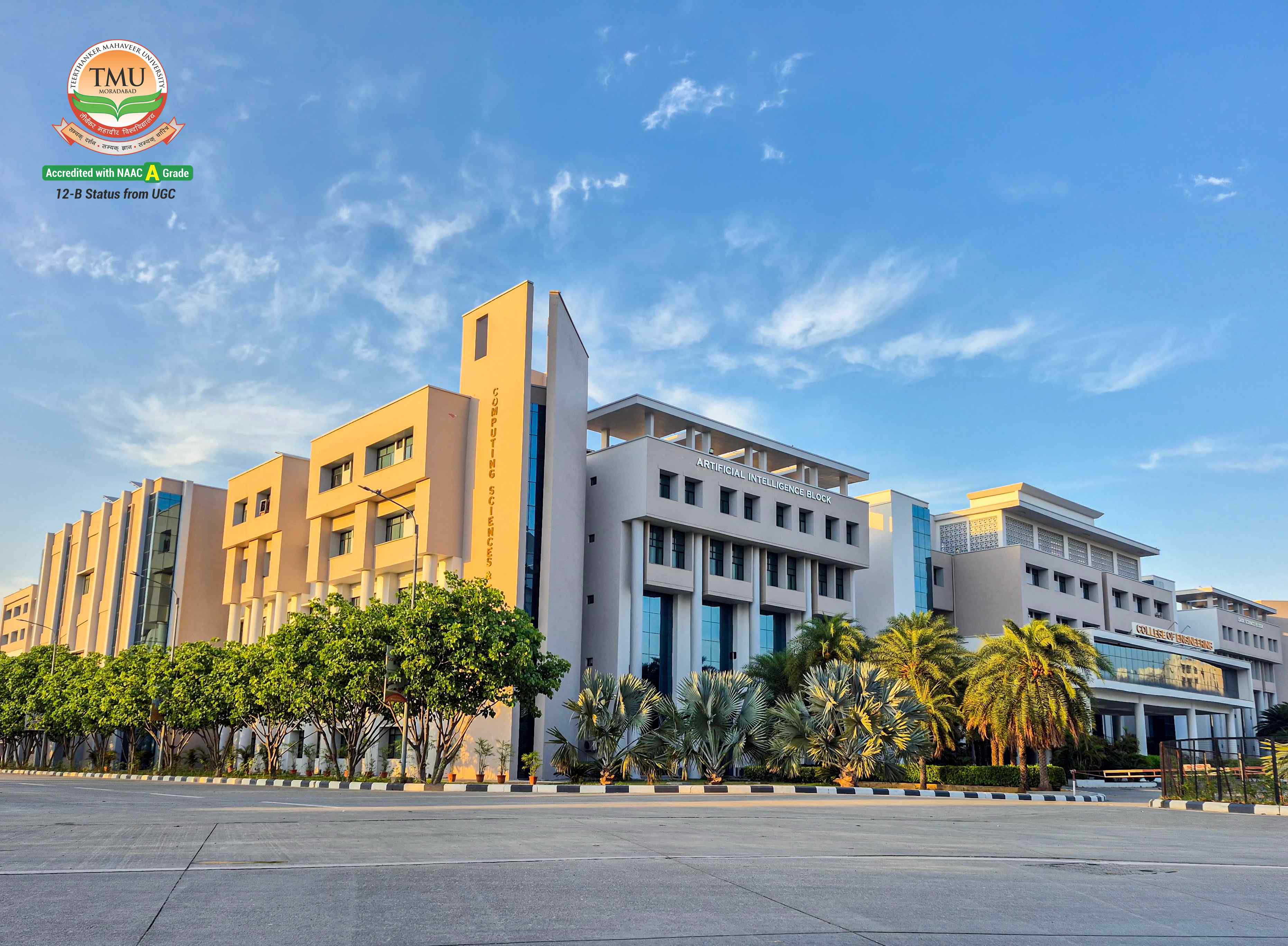
Teerthanker Mahaveer University is considered one of the best universities in UP for pursuing technology and engineering programmes. The university offers a well-structured B.Tech CSE with Data Science programme under a future-ready curriculum.
Accreditations and Rankings of TMU
- NAAC ‘A’ Grade, 12 B Status from UGC, ICAR Accredited.
- NBA Accreditation for the B.Tech. CSE Programme.
- Secured the 19th spot among India’s Top 40 Private Universities as per the Times B-school Rankings 2024.
- Green Rankings – 2024 Diamond Band with Grade A+.
- 1st Private University in India, housing a Centre of Excellence in Cyber Security.
- Ranked among the Top 10 Private Universities in UP in the IIRF University Ranking 2023.
Educational Excellence
- UGC Approval for over 150+ Programs
- Global Internship Opportunities.
- Outcome-based curriculum, innovative pedagogy that is skill-oriented, learner-centred, and holistic.
- The College of Computing Science & IT is a member of the Computer Society of India (CSI).
Admission Process for Data Science At TMU
Eligibility Criteria
For admission into the B.Tech CSE data science course at TMU, you have to meet the following eligibility criteria:
- Must pass 10+2 with 50% marks.
- The core subjects should be Physics, Chemistry, Mathematics, or Computer Science.
- Only students from science streams are eligible to apply for the data science course.
Application Registration
- Submit the application form, available on the official admission page of TMU.
- Fill out all the personal information like name, DOB, email, mobile number, and programme details.
Entrance Exam/Merit
- Entrance Score: For the data science course, TMU considers the entrance exam score, such as JEE Main or CUET.
- Merit-Based: The university also grants admission based on your academic merit.
- For accurate and the latest information, kindly contact the TMU admission cell.
Checklist of Required Documents
- 10th marksheet
- 12th marksheet
- Identity proof
- Passport-size Photograph
- Category Certificate (where necessary)
- The additional papers may be needed.
Counselling & Final Enrolment
- Depending on your score, you will get a call for counselling or an interview.
- After a successful counselling session, you have to submit the documents again to verify.
- Pay the admission fee and confirm your seat.
Additional Assistance
- The university provides a convenient and secure application process.
- Contact the TMU admission helpline at 1800-270-1490 or WhatsApp 9258112544 and get individual help.
Conclusion
Data Science is rapidly expanding and most sought-after profession of the day, with numerous opportunities available in various fields. By opting for a structured Data Science program, aspirants can unlock exciting career prospects as data analysts, AI specialists, machine learning engineers, and more, ensuring a future-ready and rewarding professional journey.
Common Questions
Q1. What is a data science course about?
Ans. The Data Science course is the study of collecting, analysing and interpreting large amounts of data to extract meaningful information.
Q2. What are the four types of data science?
Ans. The four primary types of data science analytics, representing a progression in complexity, are Descriptive (What happened?), Diagnostic (Why did it happen?), Predictive (What will happen?), and Prescriptive (What should we do?).
Q3. Is data science an IT job?
Ans. Data Science is considered an IT job for several reasons: It uses programming languages like Python and SQL.
Q4. What is a data science salary?
Ans. A data science salary can range widely, starting from ₹4-6 LPA for freshers in India to ₹30 LPA+ for senior experts.
This content gives an overview of the programme and is for educational purposes only. For updated admission guidelines and counselling support, please connect with our Counsellor Team.