



How is AI Transforming the Pharmaceutical Industry?
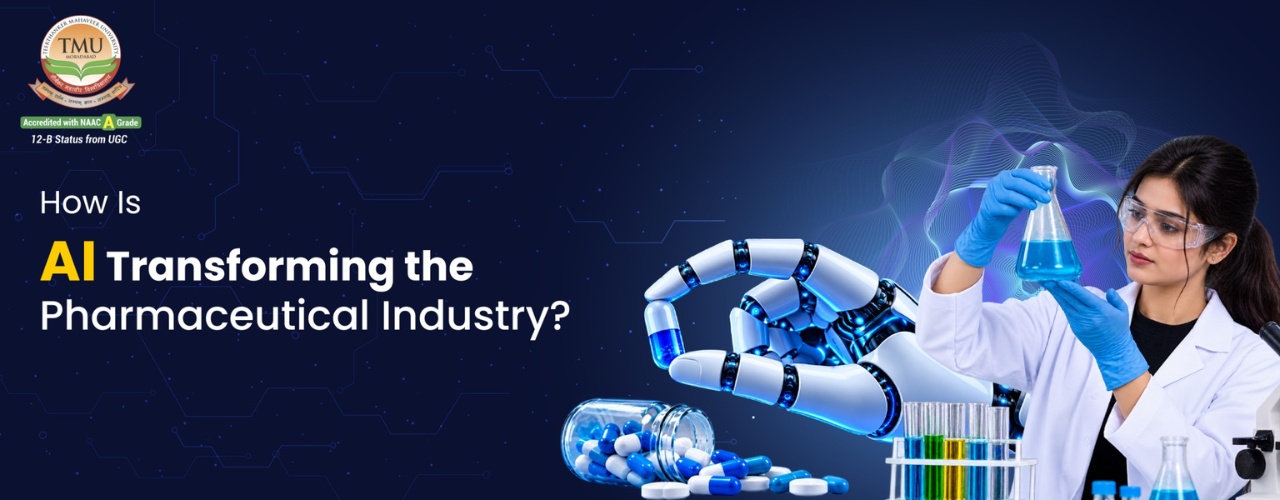
Table of Contents
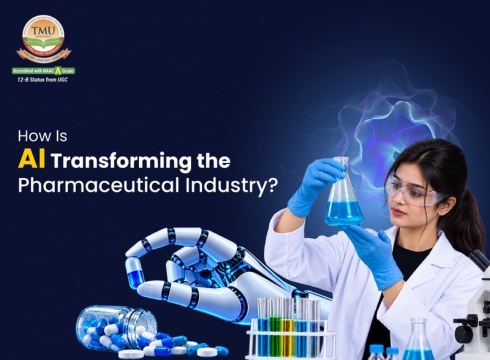
AI is changing the pharmaceutical industry by making the process of discovering new medicines faster and more efficient. It helps to improve drug manufacturing, speed up research, and provide better patient care. In simple terms, AI is helping pharmaceutical companies work smarter, save time, and develop better healthcare solutions.
Traditionally, drug development was a lengthy process involving years of research, lab work, clinical trials and massive amounts of money. With the advent of AI, however, researchers can now analyse huge volumes of data, identify potential drug candidates, predict the likely outcomes and in general improve the drug development process.
So how is AI transforming the pharmaceutical industry? Let's look at its key applications, the benefits and drawbacks and what the future might hold.
What Is the Role of AI in the Pharmaceutical Industry?
In pharma, AI is used in a variety of ways, including Machine Learning (ML), Natural Language Processing (NLP), Real-World Data (RWD) analytics and Deep Learning to improve pharma operations. Some major applications of AI in the pharmaceutical industry include:
1. AI in drug discovery and development:
AI is making the drug discovery and development process more efficient and more effective by analysing huge volumes of chemical and biological data to find potential drug leads.
2. Improved Clinical Trials:
Clinical trials are important for testing the safety of new medicines before they are given to patients. AI helps pharmaceutical companies improve clinical trial planning and management through data analysis and predictive models.
3. Personalised Medicine:
Every medicine affects different patients differently because of genetics, lifestyle, and medical history. AI supports personalised medicine by analysing patient data, genetic information, and medical records to identify patterns that may help healthcare professionals make informed treatment decisions.
4. AI in pharmaceutical manufacturing:
Pharmaceutical manufacturing is all about accuracy, effectiveness and, of course, quality. A small error can have a massive impact on patient safety. AI is being used by pharma companies to improve their manufacturing operations through automation, predictive analytics and real-time monitoring.
5. AI in drug quality control and safety:
Every medicine has to be assessed in terms of safety and quality specifications prior to being available on the market. AI-driven technologies can be used to analyse the production data, assess the production specifications and detect errors which would not be picked up by a manual inspection.
Teerthanker Mahaveer University
Apply for Admission
Apply for Admission
Benefits of AI in the Pharmaceutical Industry
The adoption of AI offers various advantages to pharmaceutical industries, researchers, and healthcare professionals.
Some of the major benefits include:
- Faster drug discovery.
- Improved efficiency of the research process.
- Better clinical trial management.
- Improved quality control.
- Reduced operational costs.
- Effective drug safety monitoring.
What Are the Challenges of Using AI in the Pharmaceutical Industry?
Artificial intelligence offers both benefits and challenges to the pharmaceutical industry. On the one hand, AI speeds up the drug research and discovery process, while on the other hand, it also brings several challenges such as:
- Lack of data availability
- Lack of transparency
- Biases in data
- Data interoperability
- A limited ability to account for variability
- Interpretation of the results
- Consideration of ethics
- Biological systems with complexity
- A lack of clinical expertise in the teams that build the models
- Training sets dominated by inactive molecules
Future of AI in the Pharmaceutical Industry
The future of AI in pharma is going to be about the wider application of intelligent technologies across the whole of R&D, manufacturing and healthcare.
As AI algorithms get more sophisticated and we get better access to high-quality data, pharma companies may be able to develop more efficient research methodologies and make better decisions.
Some important future developments may include:
- Greater use of AI in drug molecule design.
- More personalised medicine approaches.
- AI-powered automation in pharmaceutical manufacturing.
- Improved prediction of drug safety and effectiveness.
- Larger use of digital technologies in clinical trials.
- Better integration of AI with biotechnology and genomic research.
However, the success of these developments will depend on scientific validation, regulatory oversight, data security, and collaboration between AI specialists and pharmaceutical professionals.
How is AI changing pharmaceutical education?
Artificial intelligence (AI) is changing pharma education by updating the syllabus with data and computational skills, introducing virtual labs and AI lectures and training students to use AI in drug discovery and clinical care.
TMU offer various pharmaceutical education programs:
D.Pharm Courses (Diploma in Pharmacy):
D.Pharm is a two-year diploma pharmacy programme designed for students interested in the pharmaceutical industry. It is an entry-level qualification for individuals who dream of becoming pharmacists.
B.Pharm ( Bachelor of Pharmacy):
B.Pharm is an undergraduate programme of 4 years that focuses on pharmaceutical sciences, drug formulation, and patient care. It prepares students for careers in medicine manufacturing, healthcare, research, and pharmacy practice.
M.Pharm ( Master of Pharmacy):
M.Pharm is a postgraduate degree in pharmaceutical sciences of 2 years (4 semesters) that mainly focuses on advanced learning of medicines, drug development, pharmaceutical research, and clinical pharmacy. It is regulated by the Pharmacy Council of India (PCI) in India.
Pharm.D ( Doctor of Pharmacy):
Pharm.D is a 6-year ( 5 years of coursework plus 1 year of hospital clinical internship) doctoral degree that mainly focuses on pharmacotherapeutics, drug interactions, adverse drug monitoring, patient counselling, and clinical rounds.
What career opportunities does AI create in the pharmaceutical industry?
The growth of Artificial Intelligence in the field of the pharmaceutical industry is creating new opportunities for students and professionals interested in healthcare, pharmaceutical sciences, biotechnology, and technology.
Students with a pharma background can look at a number of career options by building up their skills in data analysis, AI and pharmaceutical research.
Some emerging career options include:
- Pharmaceutical Research Scientist
- Clinical Research Associate (CRA)
- Pharmacovigilance Associate
- Bioinformatics Analyst
- Computational Drug Discovery Researcher
- Pharmaceutical Data Analyst
Conclusion:
AI is contributing significant changes in pharma research, drug discovery, clinical development, and maintaining safety standards. From helping researchers identify significant compounds to supporting quality monitoring and data analysis, AI offers new tools for addressing complex scientific challenges.
However, the success of AI in the pharma industry depends on knowledge of technology and knowledgeable professionals.
FAQs
Q1. What are the top 5 pharmaceutical companies?
Ans. The top five pharma/biotech companies in the world are Johnson & Johnson, Sinopharm, Roche, Eli Lilly & Co. and Merck & Co. (the rankings will of course vary depending on the metric and region).
Q2. Which AI tool is best for the pharmaceutical industry?
Ans. Only one AI tool is not enough for the entire pharmaceutical industry; selecting a tool depends on different activities. Tools can be used such as: IQVIA AI, Medidata, Trials360.ai, Pharma.AI (Biology42, Chemistry42, Medicine42), Atomwise, BenchSci, and AlphaFold.
Q3. Will AI replace B Pharm?
Ans. AI won't replace the B.Pharm pharmacist or the degree itself. It will be used to automate the routine tasks, to analyse the big data and to help with the development of personalised medicines.
Q4. Which pharma companies are using AI?
Ans. Companies like AstraZeneca, Novartis, Sanofi, Pfizer, Eli Lilly, Roche and other major companies adopt AI for drug discovery, clinical trials, personalised medicines, and manufacturing.
Q5. Is AI used in drug development?
Ans. Yes, AI is frequently used in drug development, from the discovery stage to personalised medicines and critical care. It improves the efficiency of the pharma industry.
This content gives an overview of the programme and is for educational purposes only. For updated admission guidelines and counselling support, please connect with our Counsellor Team.