



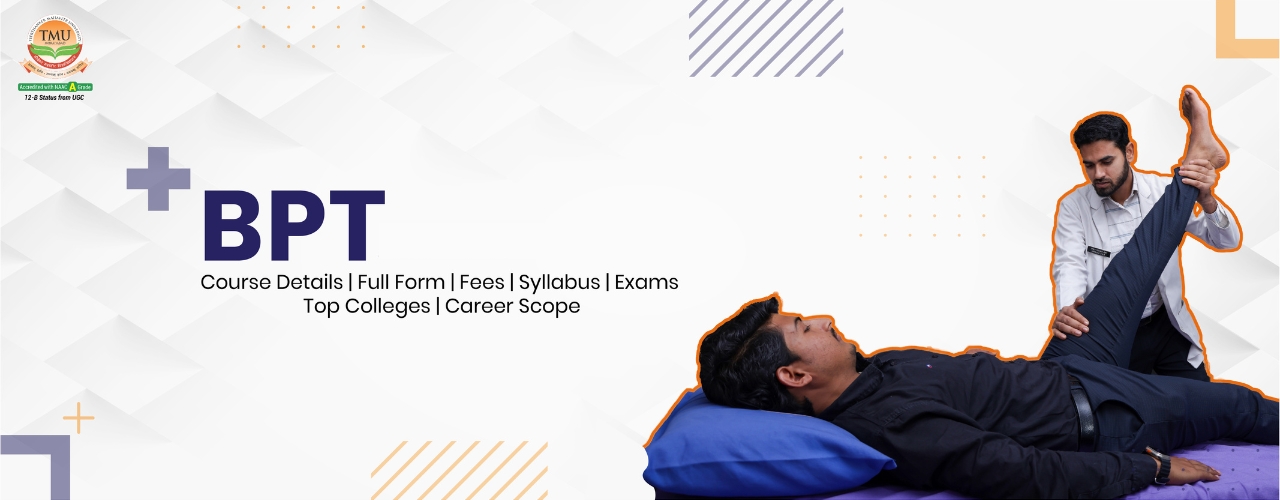
Are you interested in the medical field but looking for a career beyond MBBS? This is where physiotherapy makes a difference. If you are passionate about helping people recover from injuries and manage physical disabilities, pursuing a BPT course can be a suitable career choice.
What is the BPT Course?
BPT is an undergraduate degree programme that trains students to assess, diagnose and treat physical injuries and movement disorders using non-surgical, exercise-based methods. The programme includes 4 years of academic learning and a mandatory 6-month clinical internship, providing practical exposure in hospitals, rehabilitation centres, sports clinics, and healthcare facilities.
The programme combines theoretical knowledge with practical training through lab sessions and clinical exposure, helping students understand human anatomy, physical disorders and rehabilitation techniques. It prepares students for careers in hospitals, rehabilitation centres, sports clinics, physiotherapy centres, and healthcare organisations.
What Is the Full Form of BPT?
BPT stands for the Bachelor of Physiotherapy, a 4.5-year undergraduate degree programme that focuses on physiotherapy and rehabilitation science. The programme helps students understand how the human body functions, how joints work, and how different physical conditions affect a human’s daily activities.
BPT Course Overview
- Course Name: BPT
- Full Form: Bachelor of Physiotherapy
- Course Level: Undergraduate
- Duration: 4.5 years (including internship)
- Eligibility: 10+2 with Physics, Chemistry and Biology
- Main Subjects: Anatomy, Physiology, Exercise Therapy, Biomechanics
- Career Opportunities: Hospitals, Clinics, Rehabilitation Centres, Sports Centres
- Higher Studies: MPT (Master of Physiotherapy)
BPT Course Syllabus: Year-Wise Subjects
The BPT curriculum generally covers four academic years, followed by a six-month compulsory internship. The subjects gradually move from basic medical sciences to advanced physiotherapy techniques and clinical practice.
First Year – Basic Medical Sciences
- Human Anatomy
- Human Physiology
- Biochemistry
- Psychology
- Sociology
- Fundamentals of Biomechanics
- Basic Exercise Therapy
Second Year – Physiotherapy Fundamentals
- Pathology
- Microbiology
- Pharmacology
- Exercise Therapy
- Electrotherapy
- General Medicine
- General Surgery
Third Year – Clinical and Specialised Studies
- Orthopaedics and Traumatology
- Neurology
- General Medicine and Paediatrics
- Cardiothoracic Conditions
- Physiotherapy Assessment
- Community Physiotherapy
- Research Methodology
Fourth Year – Advanced Physiotherapy
- Physiotherapy in Orthopaedic Conditions
- Physiotherapy in Neurological Conditions
- Cardiopulmonary Physiotherapy
- Sports Physiotherapy
- Rehabilitation Techniques
- Biostatistics
- Research Project
- Clinical Training
Compulsory Internship – Six Months
After completing the academic programme, students undergo a compulsory clinical internship. During this period, they gain practical experience in patient assessment, treatment planning, rehabilitation exercises, and physiotherapy care under professional supervision.
Note: This is a general curriculum overview. The exact subjects, semester distribution, and internship structure may vary by university.
What Are the Admission Requirements for the BPT Course in India?
To be eligible for the BPT course in India, students are required to meet the following eligibility criteria:
- Candidates must pass 10+2 from a recognised board.
- Must have science subjects such as physics, chemistry or biology.
- Non-medical students are not eligible to apply for the BPT course.
- Minimum 50% aggregate marks (45% for reserved categories as per institutional norms).
- Must qualify for NEET UG under current admission regulations.
How to Apply for the BPT Admission?
The admission process generally involves the following steps:
- Choose a university: Search for universities or colleges offering BPT programmes. Compare their curriculum, eligibility and admission requirements.
- Fill out the application form: Visit the official admission portal of your chosen college and fill out the application form, including your details such as name, course name, mobile number and other required information.
- Appear for an entrance exam: Candidates are required to appear for an entrance examination for BPT admission, such as NEET, CUET UG and other state-level entrance exams.
- Counselling and Selection: Selected candidates will be called for the counselling session. After the successful selection process, candidates need to submit original documents for verification.
- Pay the Admission Fee: Once selected, pay the required admission fee to confirm your seat.
Required Documents List
- Class 10 and 12 mark sheets and certificates
- Transfer/Migration certificate
- ID proof (Aadhaar card, etc.)
- Passport-size photographs
- Category/caste certificate (if claiming reservation)
Entrance Exam for BPT Admission
Here are some of the most common BPT entrance exams in India:
Note: entrance examination requirements vary by institution.
Best Institutes Offering BPT Courses in India
Several universities and medical institutions in India offer Bachelor of Physiotherapy (BPT) programmes. Some institutes include:
- Christian Medical College (CMC), Vellore, Tamil Nadu
- Banaras Hindu University (BHU), Varanasi, Uttar Pradesh
- Teerthanker Mahaveer University (TMU), Moradabad, Uttar Pradesh
- Dr. D. Y. Patil Vidyapeeth, Pune, Maharashtra
- SRM Institute of Science and Technology, Chennai, Tamil Nadu
Career Path After BPT
- Clinical Physiotherapist: Helps patients recover from injuries, manage pain, and improve physical movement through therapeutic exercises and treatment techniques.
- Sports Physiotherapist: Works with athletes and sports professionals to prevent injuries, support recovery, and improve physical performance.
- Orthopaedic Physiotherapist: Treats patients with bone, joint, muscle, and ligament-related conditions.
- Neurological Physiotherapist: Helps patients with neurological conditions improve balance, coordination, mobility, and muscle control.
- Rehabilitation Specialist: Supports patients recovering from accidents, surgeries, injuries, and long-term physical disabilities.
- Private Physiotherapy Practitioner: Establishes an independent physiotherapy clinic and provides assessment, treatment, and rehabilitation services to patients, subject to applicable registration and practice requirements.
Average Salary After BPT in India
Note: These are indicative salary estimates, not guaranteed packages. Actual earnings may vary depending on experience, location, employer, and professional qualifications.
Why Choose TMU for BPT Education?
Pursuing a BPT programme at Teerthanker Mahaveer University (TMU) offers students a blend of classroom teaching and hands-on learning through laboratory sessions, demonstrations, and clinical exposure. The BPT programme at TMU focuses on developing a strong understanding of human anatomy, movement science, and physical rehabilitation.
H3- Key Reasons to Choose TMU
- Practical Learning: TMU provides hands-on training to help students understand physiotherapy techniques, patient care, and rehabilitation practices.
- Clinical Exposure & Community Outreach: Students get opportunities to participate in health camps, rural outreach programmes, and hospital training to develop practical skills and awareness of community healthcare needs.
- Teaching Hospital: TMU has its own multi-speciality teaching hospital, where students get opportunities to observe and learn in real healthcare settings, develop clinical skills, and gain practical experience.
- Programme Approval: The physiotherapy programmes at TMU are approved by the Government of Uttar Pradesh and the Uttar Pradesh State Medical Faculty. These approvals support the academic and professional recognition of the programmes.
- Placement & Internship Opportunities: TMU gives placement assistance to BPT students and internship opportunities at the hospital, helping them prepare for careers in hospitals, clinics, and rehabilitation centres.
Conclusion
Bachelor of Physiotherapy (BPT) is an ideal career choice for students who have an interest in healthcare, physical rehabilitation, and patient care. The programme involves both theory lessons and clinical and practical sessions, which enable students to acquire the necessary physiotherapy skills.
Before choosing this programme, students should understand its eligibility criteria, admission process, course fees, syllabus, and career opportunities. Choosing a renowned college that offers appropriate clinical training opportunities and hands-on experience can help lay a solid foundation for a career in physiotherapy.
FAQ
Q1. Is BPT a doctor's degree?
Ans. No, BPT is not a doctor's degree; it is an undergraduate healthcare degree programme which trains students to become physiotherapists. It focuses on the body's movement, recovery from injuries, management of pain and enhancing a patient's mobility. It is different from an MBBS degree.
Q2. Which is best, MBBS or BPT?
Ans. Both courses offer different career opportunities. MBBS is mainly based on the diagnosis and treatment of diseases through medical practice, and BPT is based on physical rehabilitation and movement-related problems. The choice depends on your interests and career goals.
Q3. Is NEET required for the BPT course?
Ans. NEET-UG is now mandatory for admission to BPT programmes in India under the latest admission guidelines. Students should also look into the admission policy of the university they are applying to.
Q4. What are the BPT course fees in India?
Ans. BPT course fees in India vary depending on the college and facilities. Private colleges may charge approximately ₹50,000 to ₹4 lakh or more per year, while government colleges generally have lower fees.
Q5. Is BPT better than BSc?
Ans. BPT is ideal for students who are interested in physiotherapy, patient care and physical rehabilitation. BSc is a general degree that offers specialisations in science and research-related courses. Both have different career paths, so the choice depends on individual interests.
Q6. Which college is better for BPT?
Ans. Students can consider Teerthanker Mahaveer University (TMU), BHU, Dr. D. Y. Patil Vidyapeeth, Pune, Maharashtra, and SRM Institute of Science and Technology, Chennai, Tamil Nadu. Students should choose a college that offers experienced faculty, well-equipped laboratories, hospital facilities, clinical training, and internship opportunities